

AZ-100 Exam Questions - Online Test
AZ-100 Premium VCE File

150 Lectures, 20 Hours
Your success in AZ-100 Braindumps is our sole target and we develop all our AZ-100 Exam Dumps in a way that facilitates the attainment of this target. Not only is our AZ-100 Exam Questions and Answers material the best you can find, it is also the most detailed and the most updated. AZ-100 Exam Questions and Answers for Microsoft AZ-100 are written to the highest standards of technical accuracy.
Free AZ-100 Demo Online For Microsoft Certifitcation:
NEW QUESTION 1
You have an Azure subscription named Subscription1. Subscription1 contains the virtual machines in the following table.
Subscription1 contains a virtual network named VNet1 that has the subnets in the following table.
VM3 has a network adapter named NIC3. IP forwarding is enabled on NIC3. Routing is enabled on VM3. You create a route table named RT1. RT1 is associated to Subnet1 and Subnet2 and contains the routes in the following table.
You apply RT1 to Subnet1.
For each of the following statements, select Yes if the statement is true. Otherwise, select No. NOTE: Each correct selection is worth one point.
Answer:
Explanation: Box 1: Yes
Traffic from VM1 and VM2 can reach VM3 thanks to the routing table, and as IP forwarding is enabled on VM3, traffic from VM3 can reach VM1.
Box 2: No
VM3, which has IP forwarding, must be turned on, in order for traffic from VM2 to reach VM1. Box 3: Yes
The traffic from VM1 will reach VM3, which thanks to IP forwarding, will send the traffic to VM2. References: https://www.quora.com/What-is-IP-forwarding
NEW QUESTION 2
You have an Azure subscription named Subscription1.
You have 5 TB of data that you need to transfer to Subscription. You plan to use an Azure Import/Export job.
What can you use as the destination of the imported data?
- A. Azure SQL Database
- B. Azure Data Factory
- C. A virtual machine
- D. Azure Blob storage
Answer: D
Explanation: References:
https://docs.microsoft.com/en-us/azure/storage/common/storage-import-export-service
NEW QUESTION 3
Note: This question is part of a series of questions that present the same scenario. Each question in the series contains a unique solution that might meet the stated goals. Some question sets might have more than one correct solution, while others might not have a correct solution.
After you answer a question in this section, you will NOT be able to return to it. As a result, these questions will not appear in the review screen.
You have an Azure subscription named Subscription1. Subscription1 contains a resource group named RG1. RG1 contains resources that were deployed by using templates.
You need to view the date and time when the resources were created in RG1. Solution: From the RG1 blade, you click Automation script.
Does this meet the goal?
- A. Yes
- B. No
Answer: B
NEW QUESTION 4
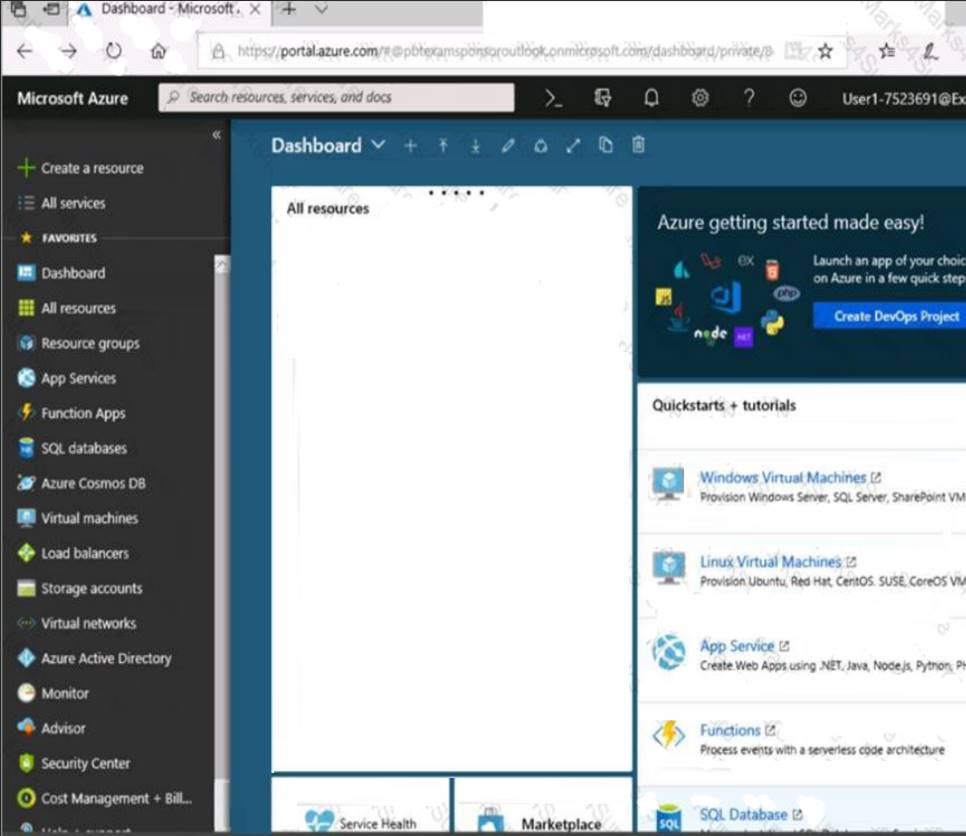
Click to expand each objective. To connect to the Azure portal, type https://portal.azure.com in the browser address bar.
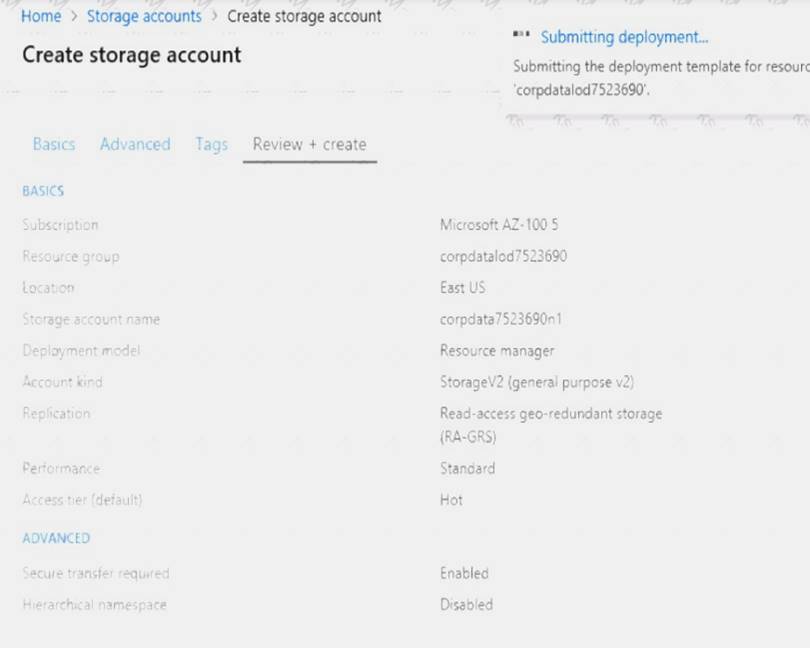
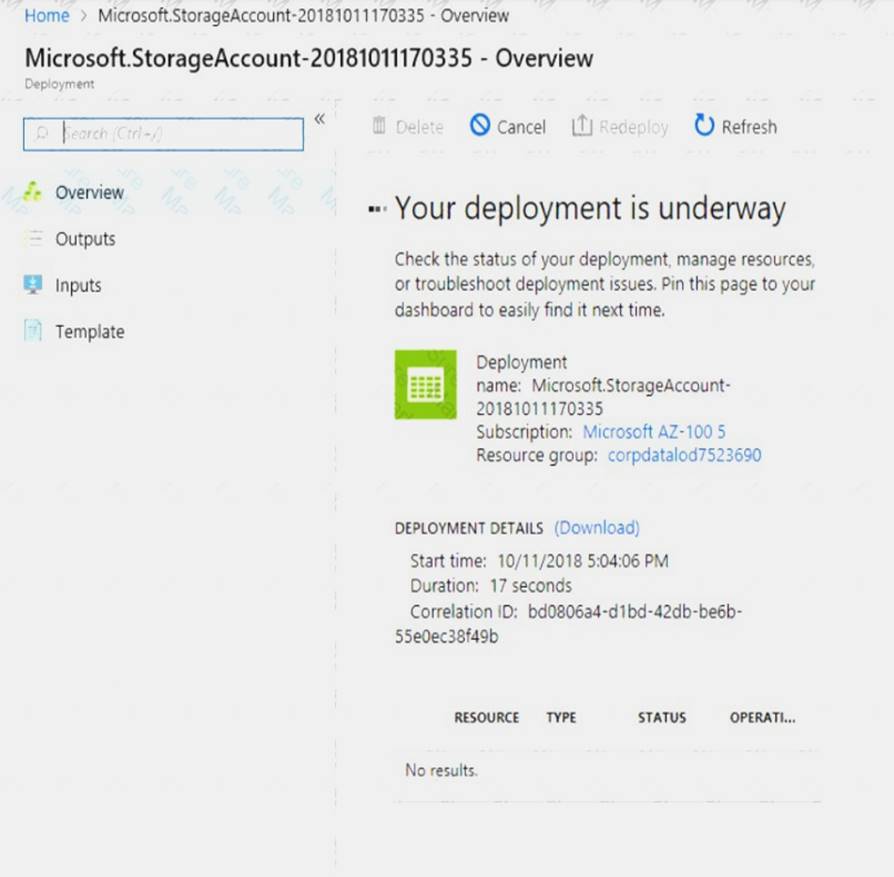
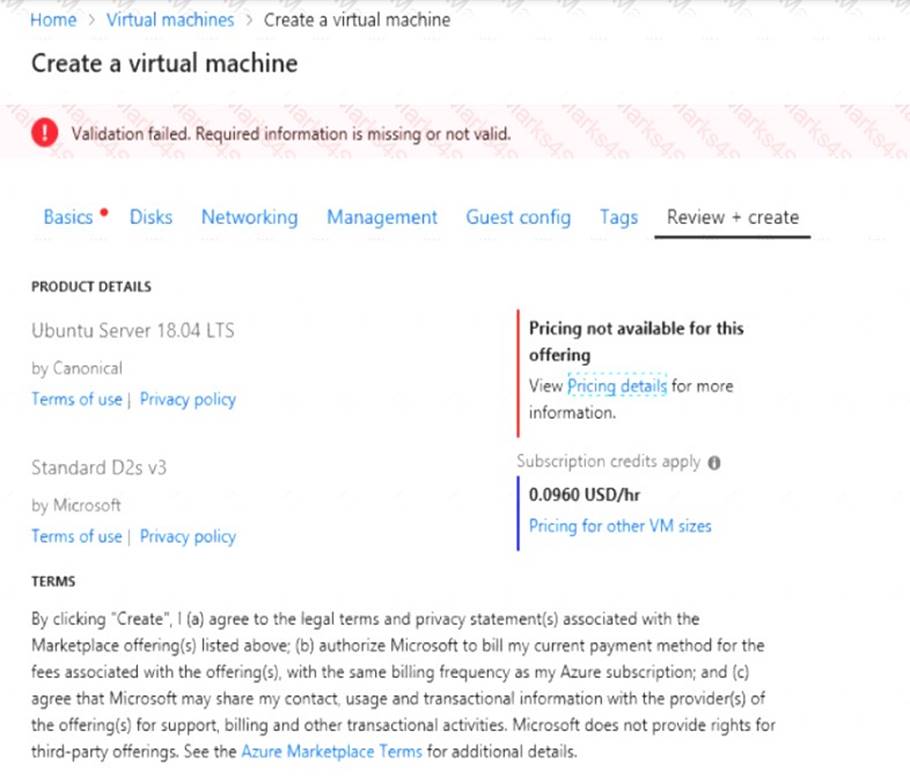
When you are finished performing all the tasks, click the ‘Next’ button.
Note that you cannot return to the lab once you click the ‘Next’ button. Scoring occur in the background while you complete the rest of the exam.
Overview
The following section of the exam is a lab. In this section, you will perform a set of tasks in a live environment. While most functionality will be available to you as it would be in a live environment, some functionality (e.g., copy and paste, ability to navigate to external websites) will not be possible by design. Scoring is based on the outcome of performing the tasks stated in the lab. In other words, it doesn’t matter how you accomplish the task, if you successfully perform it, you will earn credit for that task.
Labs are not timed separately, and this exam may have more than one lab that you must complete. You can use as much time as you would like to complete each lab. But, you should manage your time appropriately to
ensure that you are able to complete the lab(s) and all other sections of the exam in the time provided.
Please note that once you submit your work by clicking the Next button within a lab, you will NOT be able to return to the lab.
To start the lab
You may start the lab by clicking the Next button.
You plan to deploy several Azure virtual machines and to connect them to a virtual network named VNET1007.
You need to ensure that future virtual machines in VNET1007 can register their name in an internal DNS zone named corp7523690.com. The zone must NOT be hosted on a virtual machine.
What should you do from Azure Cloud Shell?
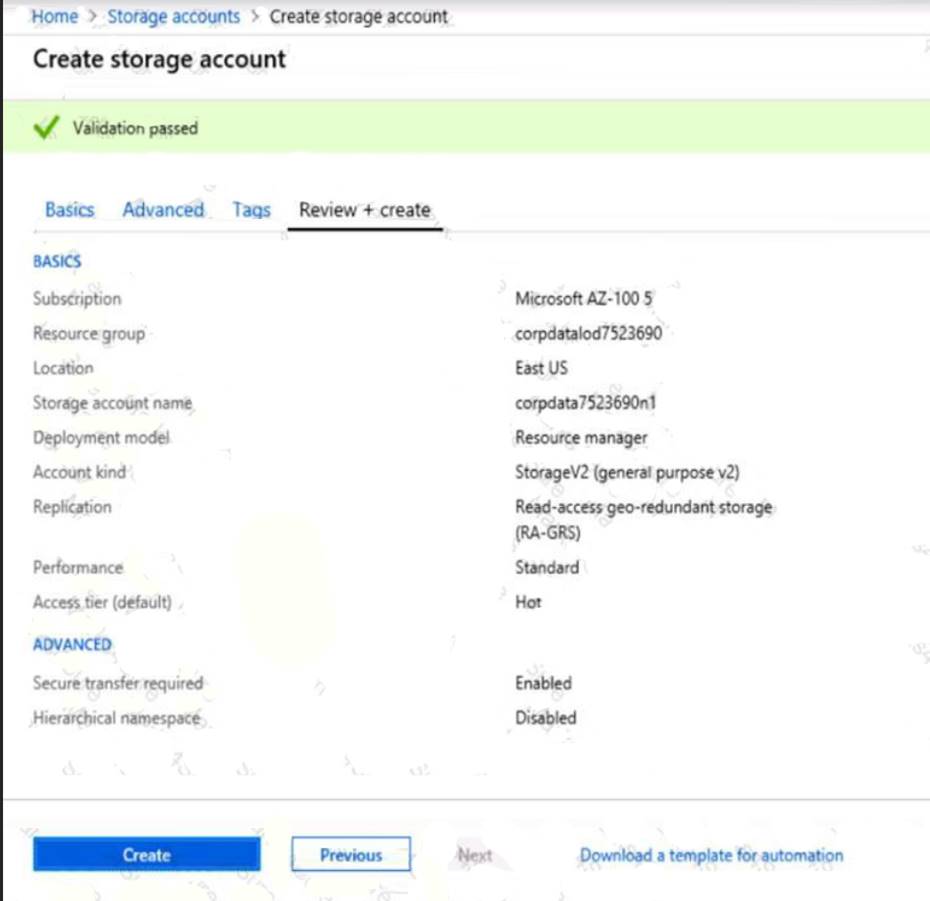
To complete this task, start Azure Cloud Shell and select PowerShell(Linux). Click Show Advanced Settings, and then enter corp7523690n1 in the Storage account text box and File1 in the File share text box. Click Create storage, and then complete the task.
Answer:
Explanation: Step 1: New-AzureRMResourceGroup -name MyResourceGroup
Before you create the DNS zone, create a resource group to contain the DNS zone.
Step 2: New-AzureRmDnsZone -Name corp7523690.com -ResourceGroupName MyResourceGroup A DNS zone is created by using the New-AzureRmDnsZone cmdlet. This creates a DNS zone called
corp7523690.com in the resource group called MyResourceGroup.
References: https://docs.microsoft.com/en-us/azure/dns/dns-getstarted-powershell
NEW QUESTION 5
You need to identify the storage requirements for Contoso.
For each of the following statements, select Yes if the statement is true. Otherwise, select No.
NOTE: Each correct selection is worth one point.
Answer:
Explanation: Box 1: Yes
Contoso is moving the existing product blueprint files to Azure Blob storage.
Use unmanaged standard storage for the hard disks of the virtual machines. We use Page Blobs for these. Box 2: No
Box 3: No
NEW QUESTION 6
You have an Azure subscription named Subscription1. Subscription1 contains the resources in the following table.
In Azure, you create a private DNS zone named adatum.com. You set the registration virtual network to VNet2. The adatum.com zone is configured as shown in the following exhibit.
For each of the following statements, select Yes if the statement is true. Otherwise, select No. NOTE: Each correct selection is worth one point.
Answer:
Explanation: Box 1: No
Azure DNS provides automatic registration of virtual machines from a single virtual network that's linked to a private zone as a registration virtual network. VM5 does not belong to the registration virtual network though.
Box 2: No
Forward DNS resolution is supported across virtual networks that are linked to the private zone as resolution virtual networks. VM5 does belong to a resolution virtual network.
Box 3: Yes
VM6 belongs to registration virtual network, and an A (Host) record exists for VM9 in the DNS zone.
By default, registration virtual networks also act as resolution virtual networks, in the sense that DNS resolution against the zone works from any of the virtual machines within the registration virtual network.
References: https://docs.microsoft.com/en-us/azure/dns/private-dns-overview
NEW QUESTION 7
You plan to deploy 20 Azure virtual machines by using an Azure Resource Manager template. The virtual machines will run the latest version of Windows Server 2021 Datacenter by using an Azure Marketplace image.
You need to complete the storageProfile section of the template.
How should you complete the storageProfile section? To answer, select the appropriate options in the answer area.
NOTE: Each correct selection is worth one point.
Answer:
Explanation: … "storageProfile": {
"imageReference": {
"publisher": "MicrosoftWindowsServer", "offer": "WindowsServer",
"sku": "2021-Datacenter", "version": "latest"
},
… References:
https://docs.microsoft.com/en-us/rest/api/compute/virtualmachines/createorupdate
NEW QUESTION 8
You have an Azure subscription named Subscription1. Subscription1 contains two Azure virtual machines named VM1 and VM2. VM1 and VM2 run Windows Server 2021.
VM1 is backed up daily by Azure Backup without using the Azure Backup agent. VM1 is affected by ransomware that encrypts data.
You need to restore the latest backup of VM1.
To which location can you restore the backup? To answer, select the appropriate options in the answer area. NOTE: Each correct selection is worth one point.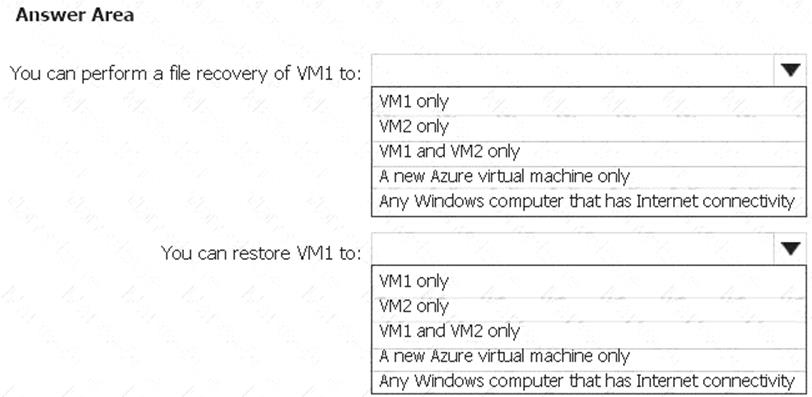
Answer:
Explanation: Box 1: VM1 only
To restore files or folders from the recovery point, go to the virtual machine and choose the desired recovery point.
Box 2: A new Azure virtual machine only
On the Restore configuration blade, you have two choices:  Create virtual machine Restore disks
References:
https://docs.microsoft.com/en-us/azure/backup/backup-azure-restore-files-from-vm https://docs.microsoft.com/en-us/azure/backup/backup-azure-arm-restore-vms
NEW QUESTION 9
You plan to deploy five virtual machines to a virtual network subnet.
Each virtual machine will have a public IP address and a private IP address. Each virtual machine requires the same inbound and outbound security rules.
What is the minimum number of network interfaces and network security groups that you require? To answer, select the appropriate options in the answer area.
NOTE: Each correct selection is worth one point.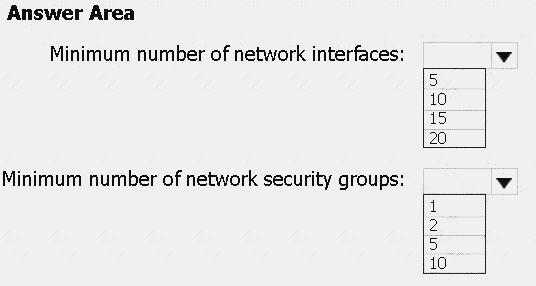
Answer:
Explanation: Box 1: 10
One public and one private network interface for each of the five VMs. Box 2: 1
You can associate zero, or one, network security group to each virtual network subnet and network interface in a virtual machine. The same network security group can be associated to as many subnets and network interfaces as you choose.
References:
https://docs.microsoft.com/en-us/azure/virtual-network/security-overview
NEW QUESTION 10
You need to prepare the environment to ensure that the web administrators can deploy the web apps as quickly as possible.
Which three actions should you perform in sequence? To answer, move the appropriate actions from the list of actions to the answer area and arrange them in the correct order.
Answer:
Explanation: Step 1:
First you create a storage account using the Azure portal. Step 2:
Select Automation options at the bottom of the screen. The portal shows the template on the Template tab. Deploy: Deploy the Azure storage account to Azure.
Step 3:
Share the template.
Scenario: Web administrators will deploy Azure web apps for the marketing department. Each web app will be added to a separate resource group. The initial configuration of the web apps will be identical. The web administrators have permission to deploy web apps to resource groups.
References:
https://docs.microsoft.com/en-us/azure/azure-resource-manager/resource-manager-quickstart-create-templates-u
NEW QUESTION 11
You have an Azure subscription that contains a resource group named RG1. RG1 contains 100 virtual machines.
Your company has three cost centers named Manufacturing, Sales, and Finance. You need to associate each virtual machine to a specific cost center.
What should you do?
- A. Add an extension to the virtual machines.
- B. Modify the inventory settings of the virtual machine.
- C. Assign tags to the virtual machines.
- D. Configure locks for the virtual machine.
Answer: C
Explanation: References:
https://docs.microsoft.com/en-us/azure/billing/billing-getting-started https://docs.microsoft.com/en-us/azure/azure-resource-manager/resource-group-using-tags
NEW QUESTION 12
You have an Azure subscription named Subscription1. Subscription1 contains a virtual machine named VM1. You have a computer named Computer1 that runs Windows 10. Computer1 is connected to the Internet.
You add a network interface named Interface1 to VM1 as shown in the exhibit (Click the Exhibit button.)
From Computer1, you attempt to connect to VM1 by using Remote Desktop, but the connection fails. You need to establish a Remote Desktop connection to VM1.
What should you do first?
- A. Start VM1.
- B. Attach a network interface.
- C. Delete the DenyAllOutBound outbound port rule.
- D. Delete the DenyAllInBound inbound port rule.
Answer: A
NEW QUESTION 13
You have an Azure Active Directory (Azure AD) tenant that has the initial domain name. You have a domain name of contoso.com registered at a third-party registrar.
You need to ensure that you can create Azure AD users that have names containing a suffix of @contoso.com.
Which three actions should you perform in sequence? To answer, move the appropriate cmdlets from the list of cmdlets to the answer area and arrange them in the correct order.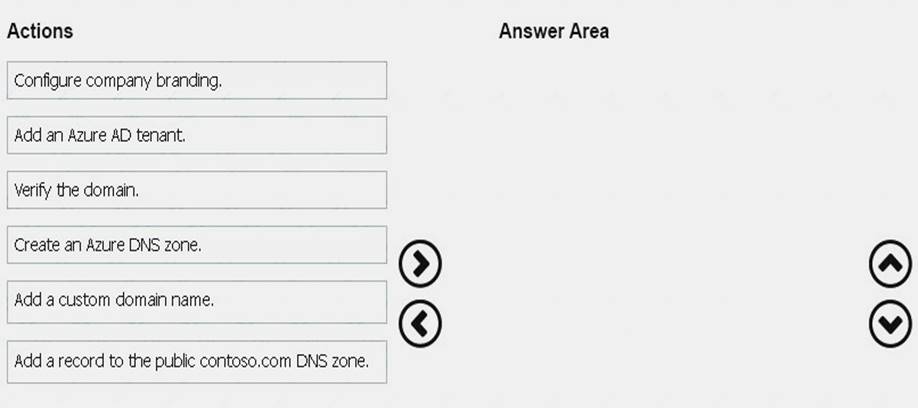
Answer:
Explanation: The process is simple: Add the custom domain name to your directory Add a DNS entry for the domain name at the domain name registrar Verify the custom domain name in Azure AD
References: https://docs.microsoft.com/en-us/azure/dns/dns-web-sites-custom-domain
NEW QUESTION 14
Note: This question is part of a series of questions that present the same scenario. Each question in the series contains a unique solution that might meet the stated goals. Some question sets might have more than one correct solution, while others might not have a correct solution.
After you answer a question in this section, you will NOT be able to return to it. As a result, these questions will not appear in the review screen.
You have an Azure subscription named Subscription1. Subscription1 contains a resource group named RG1. RG1 contains resources that were deployed by using templates.
You need to view the date and time when the resources were created in RG1. Solution: From the RG1 blade, you click Deployments.
Does this meet the goal?
- A. Yes
- B. No
Answer: A
NEW QUESTION 15
Overview
The following section of the exam is a lab. In this section, you will perform a set of tasks in a live environment. While most functionality will be available to you as it would be in a live environment, some functionality (e.g., copy and paste, ability to navigate to external websites) will not be possible by design.
Scoring is based on the outcome of performing the tasks stated in the lab. In other words, it doesn’t matter how you accomplish the task, if you successfully perform it, you will earn credit for that task.
Labs are not timed separately, and this exam may have more than one lab that you must complete. You can use as much time as you would like to complete each lab. But, you should manage your time appropriately to ensure that you are able to complete the lab(s) and all other sections of the exam in the time provided.
Please note that once you submit your work by clicking the Next button within a lab, you will NOT be able to return to the lab.
To start the lab
You may start the lab by clicking the Next button.
Your company plans to store several documents on a public website.
You need to create a container named bios that will host the documents in the storagelod8095859 storage account. The solution must ensure anonymous access and must ensure that users can browse folders in the container.
What should you do from the Azure portal?
Answer:
Explanation: Azure portal create public container
To create a container in the Azure portal, follow these steps:
Step 1. Navigate to your new storage account in the Azure portal.
Step 2. In the left menu for the storage account, scroll to the lob service section, then select Blobs. Select the + Container button.
Type a name for your new container: bios
Set the level of public access to the container: Select anonymous access.
Step 3. Select OK to create the container. References:
https://docs.microsoft.com/en-us/azure/storage/blobs/storage-quickstart-blobs-portal
NEW QUESTION 16
Note: This question is part of a series of questions that present the same scenario. Each question in the series contains a unique solution that might meet the stated goals. Some question sets might have more than one correct solution, while others might not have a correct solution.
After you answer a question in this section, you will NOT be able to return to it. As a result, these questions will not appear in the review screen.
You have an Azure virtual machine named VM1. VM1 was deployed by using a custom Azure Resource Manager template named ARM1.json.
You receive a notification that VM1 will be affected by maintenance. You need to move VM1 to a different host immediately.
Solution: From the Overview blade, you move the virtual machine to a different resource group. Does this meet the goal?
- A. Yes
- B. No
Answer: B
Explanation: You should redeploy the VM.
References: https://docs.microsoft.com/en-us/azure/virtual-machines/windows/redeploy-to-new-node
NEW QUESTION 17
You need to meet the user requirement for Admin1. What should you do?
- A. From the Subscriptions blade, select the subscription, and then modify the Properties.
- B. From the Subscriptions blade, select the subscription, and then modify the Access control (IAM) settings.
- C. From the Azure Active Directory blade, modify the Properties.
- D. From the Azure Active Directory blade, modify the Groups.
Answer: A
Explanation: Change the Service administrator for an Azure subscription
Sign in to Account Center as the Account administrator.
Select a subscription.
On the right side, select Edit subscription details.
Scenario: Designate a new user named Admin1 as the service administrator of the Azure subscription. References:
https://docs.microsoft.com/en-us/azure/billing/billing-add-change-azure-subscription-administrator
NEW QUESTION 18
You have an Azure subscription that contains 100 virtual machines. You regularly create and delete virtual machines.
You need to identify unused disks that can be deleted. What should you do?
- A. From Microsoft Azure Storage Explorer, view the Account Management properties.
- B. From the Azure portal, configure the Advisor recommendations.
- C. From Cloudyn, open the Optimizer tab and create a report.
- D. From Cloudyn, create a Cost Management report.
Answer: A
Explanation: References:
https://cloud.netapp.com/blog/reduce-azure-storage-costs
NEW QUESTION 19
You need to recommend an identify solution that meets the technical requirements. What should you recommend?
- A. federated single-on (SSO) and Active Directory Federation Services (AD FS)
- B. password hash synchronization and single sign-on (SSO)
- C. cloud-only user accounts
- D. Pass-through Authentication and single sign-on (SSO)
Answer: A
Explanation: Active Directory Federation Services is a feature and web service in the Windows Server Operating System that allows sharing of identity information outside a company’s network.
Scenario: Technical Requirements include:
Prevent user passwords or hashes of passwords from being stored in Azure. References: https://www.sherweb.com/blog/active-directory-federation-services/
Topic 3, Mix Questions
NEW QUESTION 20
You need to move the blueprint files to Azure. What should you do?
- A. Generate a shared access signature (SAS). Map a drive, and then copy the files by using File Explorer.
- B. Use the Azure Import/Export service.
- C. Generate an access ke
- D. Map a drive, and then copy the files by using File Explorer.
- E. Use Azure Storage Explorer to copy the files.
Answer: D
Explanation: Azure Storage Explorer is a free tool from Microsoft that allows you to work with Azure Storage data on Windows, macOS, and Linux. You can use it to upload and download data from Azure blob storage.
Scenario:
Planned Changes include: move the existing product blueprint files to Azure Blob storage. Technical Requirements include: Copy the blueprint files to Azure over the Internet. References:
https://docs.microsoft.com/en-us/azure/machine-learning/team-data-science-process/move-data-to-azure-blob-us
100% Valid and Newest Version AZ-100 Questions & Answers shared by 2passeasy, Get Full Dumps HERE: https://www.2passeasy.com/dumps/AZ-100/ (New 106 Q&As)
- Microsoft AZ-202 Exam Dumps 2021
- How Many Questions Of MS-301 Pdf Exam
- The Secret of Microsoft 70-413 practice test
- Regenerate Microsoft 70-410 practice test
- What 100% Guarantee 70-480 exam Is?
- Renewal Microsoft Dynamics 365 For Finance And Operations-Supply Chain Management (beta) MB-330 Testing Bible
- Microsoft 70-475 Braindumps 2021
- The Renovate Guide To 70-461 practice test
- Practical 70-537 Exam Questions and Answers 2021
- Microsoft 70-765 Dumps Questions 2021