

1Z0-134 Exam Questions - Online Test
1Z0-134 Premium VCE File

150 Lectures, 20 Hours

Proper study guides for Regenerate Oracle Oracle WebLogic Server 12c: Advanced Administrator II certified begins with Oracle 1Z0-134 preparation products which designed to deliver the Practical 1Z0-134 questions by making you pass the 1Z0-134 test at your first time. Try the free 1Z0-134 demo right now.
Free demo questions for Oracle 1Z0-134 Exam Dumps Below:
NEW QUESTION 1
Which two statements are true about the role of cluster master in whole server migration? (Choose two.)
- A. There is exactly one cluster master in the cluster at a given point of time.
- B. The cluster master must host all the pinned services in the cluster.
- C. Any managed server in the cluster can serve as the cluster master.
- D. A cluster master must always be different from a singleton master.
- E. The cluster master must always be started with the node manage
Answer: AC
Explanation:
One server instance in a cluster that contains migratable servers acts as the cluster master and orchestrates the process of automatic server migration, in the event of failure.
Any Managed Server in a cluster can serve as the cluster master, whether it hosts pinned services or not.
Note: Any server instance in the cluster can serve as the cluster master. When you start a
cluster that contains migratable servers, the first server to join the cluster becomes the cluster master and starts up the cluster manager service. If a cluster does not include at least one migratable server, it does not require a cluster master, and the cluster master service does not start up.
NEW QUESTION 2
A hardware load-balancer (HWLB) is positioned as the primary entry point into your WebLogic Server domain. Aspects of your application use SSL to protect data on the network from your clients to your domain.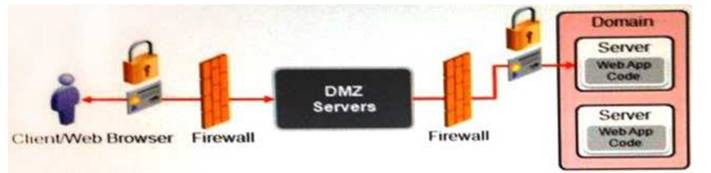
- A. Configure the HWLB to use an SSL hardware accelerator and terminate SSL.
- B. Configure the HWLB to use pass-through SSL, configure an SSL hardware accelerator on WebLogic, and terminate SSL.
- C. Configure the HWLB to delegate SSL handling to the WebLogic Proxy Plug-in and terminate SSL.
- D. Configure the HWLB to use pass through SSL to the WebLogic Server that it connects to, and terminate SS
Answer: A
Explanation:
In most of the architectures, the SSL is terminated at the hardware load balancer for performance reasons and allows the internal traffic to use HTTP for communication.
NEW QUESTION 3
You are asked to configure Node Manager for your production environment. You are considering whether to use the Java version or the script-based version of Node Manager.
Which statement correctly describes the difference between the two versions?
- A. If you are installing WebLogic Server on a Windows system, you must use the Java version of Node Manager.
- B. The script-based version of Node Manager can be used in conjunction with inetd on supported UNIX systems.
- C. The script-based version of Node Manager requires a larger footprint than the Java version.
- D. When Node Manager is used for consensus leasing, you may see faster performance with the script-based version.
Answer: A
Explanation:
Java-based Node Manager runs within a Java Virtual Machine (JVM) process. It is recommended that you run it as a Windows service on Windows platforms and as an operating system service on UNIX platforms.
For UNIX and Linux systems, WebLogic Server provides a script-based version of Node Manager.
NEW QUESTION 4
You manage an application that uses SAML tokens from a trusted voucher to provide single sign-on for virtual clients of your WebLogic domain. Your domain uses an identity assertion provider to manage this authentication.
Clients are failing to authenticate. Client return codes and server log files do not include any useful information that can he used to discern where the issue lies.
What do you do to determine the problem?
- A. Configure SAML and provider debugging, perform a test client request, and analyze the server logs for errors.
- B. Inspect network packets to examine token data because, for security purposes, the server does not provide detailed information.
- C. Configure the security debug log, perform a test client request, and analyze the log for errors.
- D. Reorder the SAML identity asserter provider to determine if the problem is related to virtual user
Answer: A
Explanation:
You can enable debug scopes or attributes by passing them as options in the command that starts WebLogic Server. You can configure SAML debugging either through command line options by using the WebLogic Server Administration Console.
NEW QUESTION 5
Even though your company has a thorough procedure for testing applications in a pre-production environment prior to production deployment, you have decided to conduct additional testing of a particular application after it is deployed. You choose to deploy the application in administration mode.
Which three statements are true? (Choose three.)
- A. The application deployment must use the –redeploy option using a unique version string.
- B. You must configure an administration port for the entire domain, or an administration channel for the targeted server.
- C. The application must first be distributed to the targeted server prior to starting it in administration mode.
- D. The application cannot have any dependencies on any shared Java EE libraries.
- E. After testing, the application can be dynamically transitioned to start accepting all client request
Answer: BCE
Explanation:
B: Distributing an application copies deployment files to target servers and places the application in a prepared state. You can then start the application in Administration mode, which restricts access to the application to a configured Administration channel so you can perform final testing without opening the application to external client connections or disrupting connected clients.
C: Distributing an application prepares it for deployment by copying its deployment files to all target servers and validating it. After you distribute an application, you can start it in Administration mode, which restricts access to the application to a configured Administration channel and allows you to distribute the application to a production environment (or distribute a new version of an application) without opening the application to external client connections. E: While in Administration mode, you can connect to an application only via a configured Administration channel. This allows you to perform final (“sanity”) checking of the application directly in the production environment without disrupting clients. After performing final testing, you can either undeploy the application to make further changes, or
start the application to make it generally available to clients. References:
NEW QUESTION 6
You want to use the WebLogic Diagnostic Framework (WLDF) to monitor some historic MBean attribute values in your WebLogic domain.
Which WLDF component do you use to accomplish this? (Choose the best answer.)
- A. the Harvester with a metric collection definition
- B. a Watch on a metric collection definition
- C. the MBean Collector with a metric collection definition
- D. the Archiver with a metric collection definition
Answer: D
Explanation:
The Archive component of the WebLogic Diagnostics Framework (WLDF) captures and persists all data events, log records, and metrics collected by WLDF from server instances and applications running on them.
The Archive provides access interfaces so that the Accessor may expose any of the persisted historical data including logged event data and persisted metrics.
NEW QUESTION 7
Review the diagram below. It depicts the following:
Assuming the next request for an HTTP session attribute is a new attribute that is not stored in a near-cache, the client’s session attribute is fetched from the remaining storage-enabled server in cluster 2.
Why is the session attribute retrieved from this other server’s cache? (Choose the best answer.)
- A. Coherence*Web stores sessions in a distributed cache on the back end and the request fails over to the new location after partition re-balancing takes place.
- B. Coherence*Web stores sessions in a replicated cache on the back end and the request fails over to the new location automatically.
- C. Coherence*Web stores sessions in a shared disk cache on the back end and Coherence*Web automatically load balances requests.
- D. Coherence*Web stores sessions in a cache that is backed by a database cache loade
- E. The data is fetched from the database and placed into the cache on the new server.
Answer: A
NEW QUESTION 8
You are creating a new domain with WLST.
Identify three parameters that can be customized with the setOption command. (Choose three.)
- A. the JDK that will be used to start the domain
- B. the domain name
- C. whether or not the domain will run in production mode
- D. the default persistent store type for the domain
- E. whether or not to automatically start the Node Manager
- F. the default diagnostic profile for the domain
Answer: ABC
Explanation:
setOption sets options related to a domain creation or update. Syntax: setOption(optionName, optionValue)
Option names include:
* JavaHome—Home directory for the JVM to be used when starting the server. The default for this option depends on the platform on which you install WebLogic Server. Update JavaHome to point to the jre directory for the JDK that you are using for WebLogic Server.
* DomainName—Name of the domain.
* ServerStartMode—Mode to use when starting the server for the newly created domain. This value can be dev (development) or prod (production). This option defaults to dev.
NEW QUESTION 9
You are considering targeting your JMS servers to dynamic clusters to benefit from dynamic scaling. However, you have been advised to keep in mind some of the associated limitations.
What are two valid limitations and considerations for clustered JMS services? (Choose two.)
- A. Store-and-Forward agents cannot be targeted to a cluster (dynamic or mixed).
- B. WLST in offline mode does not support the get and set commands to target JMS servers to a dynamic cluster.
- C. A sub-deployment cannot be targeted to a duster.
- D. Targeting a messaging bridge to a dynamic cluster is not supporte
Answer: AD
Explanation:
A: Store-and-Forward (SAF) Agents cannot be targeted to a Dynamic or Mixed cluster. You can target SAF Agents to Configured clusters using the default store.
D: Targeting a messaging bridge to a mixed or dynamic cluster is not supported.
NEW QUESTION 10
As part of a manual migration of JMS-related services, you just configured a custom file store and targeted it to the same migratable target as the JMS server.
Which two statements pertain to the successful configuration of this JMS store and the manual migration? (Choose two.)
- A. The custom store could be made available to a backup server target with pre-rnigration/post-migration scripts.
- B. The custom store should not be targeted to the same migratable target as the migratable service.
- C. All the candidate servers in the migratable target should have access to this custom store.
- D. The JMS server that is using the default file store should be migrated to a migratable targe
Answer: AC
Explanation:
For persistent messaging, you must configure a custom persistent store that is targeted to the same migratable target as the JMS service. Unless you are using pre/post migration scripts to move the store data across migrated servers, the custom store must be configured such that all the candidate servers in the migratable target have access to it.
NEW QUESTION 11
Which three Weblogic server entities can be set up for service level migration? (Choose three.)
- A. JMS Server
- B. JOLT Service
- C. JTA Transaction Recovery Service
- D. User Defined Singleton Service
- E. JDBC Service
- F. JNDI Service
Answer: ACD
Explanation:
AC: WebLogic Server migration framework provides infrastructure and facilities to perform the manual or automatic migration of JMS-related services and the JTA Transaction Recovery Service.
D: WebLogic Server supports the automatic migration of user-defined singleton services. Automatic singleton service migration allows the automatic health monitoring and migration of singleton services. A singleton service is a service operating within a cluster that is available on only one server at any given time.
NEW QUESTION 12
You are managing a WebLogic domain that has the default built-in diagnostic module configured for each server in the domain.
You have the following requirements:
What are two approaches you can apply to achieve this result? (Choose two.)
- A. Clone the built-in module, add now metrics to it, deactivate the existing module, and activate your new module.
- B. Leave the built-in module, create a new module and add metrics to it, and activate your new module alongside the built-in module.
- C. Leave the built-in module, create an external resource descriptor module and add metrics to it, and activate your new module alongside the built-in module.
- D. Remove the built-in module, create an external resource descriptor module and add built-in and new metrics to it, and activate your new module alongside the built-in module.
Answer: BC
Explanation:
In a given domain, you can create multiple diagnostic system modules with distinct configurations. You can target multiple diagnostic system modules to any given server or cluster.
Note: To configure and use the Instrumentation, Harvester, and Watch and Notification components at the server level, you must first create a system resource called a diagnostic system module, which will contain the configurations for all those components. The configuration of diagnostic system module is defined in a resource descriptor. A resource descriptor can be either configured or external.
NEW QUESTION 13
Your clients are connected to distributed destinations to consume messages sent to various JMS topics.
Recently, JMS connections got interrupted due to a network failure and your clients dropped their connections as well. How would you ensure seamless failover for your clients when a distributed destination fails? (Choose the best answer.)
- A. No action should be needed at the client’s level if the failover is being handled properly at the cluster level.
- B. Set the 1ientReconnectOptions parameter to Automatic in the Administration Console under the destination configuration general page.
- C. Implement an automatic reconnect mechanism in the client exception handler.
- D. Set AutomaticClientReconnect to Enabled in the Administration Console under the destination configuration general page.
Answer: C
Explanation:
A simple way to failover a client connected to a failed distributed destination is to write reconnect logic in the client code to connect to the distributed destination after catching onException.
NEW QUESTION 14
In order to increase scalability and high availability you are configuring WebLogic clustering with JMS distributed destinations.
Which recommendation will ensure optimal load balancing of the message processing?
- A. The machines that host the cluster should have similar processing power, disk space, and memory.
- B. The cluster should include at least one configurable server.
- C. The cluster should use unicast communication.
- D. All servers in the cluster should be assigned to the same WebLogic machine.
Answer: A
Explanation:
A uniform distributed destination (UDD), compared to weighted Distributed Destinations, greatly simplifies the management and development of distributed destination applications.Using uniform distributed destinations, you no longer need to create or designate destination members, but instead rely on WebLogic Server to uniformly create the necessary members on the JMS servers to which a JMS module is targeted. This feature ensures the consistent configuration of all distributed destination parameters, particularly in regards to weighting, security, persistence, paging, and quotas.
NEW QUESTION 15
For some reason, servers in your domain are failing. The host machines are pingable and the WebLogic JVM processes are running but the getState() method on the ServerRuntimeMBean reports FAILED.
In the future, when this happens, you want these failed servers to be shut down and then restarted automatically without human intervention. At the same time, you want to constrain how much time will be spent restarting those servers and how many restart attempts will be made.
Pick the two options that would help with this situation. (Choose two.)
- A. For each server (or cluster), set RestartInterval to an appropriate positive integer.
- B. When starting Node Manager, use the WLST nmStart command and pass in a WLST properties object with RestartMax set to an appropriate positive integer.
- C. Start the servers by executing the restartManagedWebLogic.sh script in the domain’s /bin directory.
- D. Make sure all managed servers are members of a cluster with ReplicationGroupsEnabled set to tru
Answer: BC
Explanation:
B: The nmStart command identifies the server instance to start. You define the number of restarts by setting the RestartMax property in a Node Manager startup.properties file. If you use the nmStart command with WLST connected to a Node Manager, Node Manager supports monitoring, stopping, and restarting the Administration Server.
C: The script named startManagedWebLogic can be used to start Managed Servers. On a UNIX system it is located in located in DOMAIN_NAME/bin/startManagedWebLogic.sh.
NEW QUESTION 16
......
P.S. Dumps-files.com now are offering 100% pass ensure 1Z0-134 dumps! All 1Z0-134 exam questions have been updated with correct answers: https://www.dumps-files.com/files/1Z0-134/ (125 New Questions)
- What Real 1Z0-072 Pdf Is
- What Highest Quality 1Z0-447 braindumps Is?
- Oracle 1z0-1001 Braindumps 2021
- Regenerate 1Z0-435 Training Tools 2021
- Regenerate 1z0-468 Bundle 2021
- Oracle 1z0-1019 Courses 2021
- High Quality 1z0-082 Bundle 2021
- Oracle 1z0-070 Testing Material 2021
- Best Quality 1Z0-066 Free Practice Questions 2021
- How Many Questions Of 1z0-1003-20 Questions Pool