

1z0-1016 Exam Questions - Online Test
1z0-1016 Premium VCE File

150 Lectures, 20 Hours
Master the 1z0-1016 Oracle Product Hub Cloud 2021? Implementation Essentials content and be ready for exam day success quickly with this Examcollection 1z0-1016 exam cost. We guarantee it!We make it a reality and give you real 1z0-1016 questions in our Oracle 1z0-1016 braindumps.Latest 100% VALID Oracle 1z0-1016 Exam Questions Dumps at below page. You can use our Oracle 1z0-1016 braindumps and pass your exam.
Free 1z0-1016 Demo Online For Oracle Certifitcation:
NEW QUESTION 1
Identify two entities where you can define only Descriptive Flexfield segments but not Extensible Flexfields.
- A. Items
- B. Item Cross Reference
- C. Item Revision
- D. Item Supplier Site
- E. Item Catalogs
Answer: BC
Explanation:
Reference
https://docs.oracle.com/en/cloud/saas/supply-chain-management/r13-update18a/faipr/define-items.html#FAIPR1
NEW QUESTION 2
Which statement is true about the relationship between supplier users and supplier items?
- A. Item access to supplier users can be managed at the item level by using the Manage Items page.
- B. Access to supplier items can be maintained only at the OIM level.
- C. You cannot restrict item access at the supplier user level.
- D. Item access to supplier users can be managed at the item level by using the Manage Supplier User page.
Answer: D
Explanation:
Reference https://docs.oracle.com/cloud/farel12/scmcs_gs/FAPIM/FAPIM1083144.htm#FAPIM2083787
NEW QUESTION 3
You are a retail organization and your suppliers upload supplier items on a periodic basis using supplier portal. You want to make sure that suppliers enter minimal and required information and with less errors.
Identify three features you would use in order to fulfill this requirement.
- A. Smart Spreadsheets/Templates
- B. Export Suppliers
- C. Blending Rules
- D. Creation of suppliers
- E. Expose required attribute groups to Product Hub Portal
Answer: ACE
NEW QUESTION 4
During the pre-configuration workshop, you had identified multiple custom attributes that must be created on items in Product Data Hub.
Identify the option that outlines the correct steps needed to create Extensible Flexfield attributes.
- A. Create Value Set > Create Item Attribute Groups and Attributes > Deploy Flexfield > Assign Attribute Group to Item Class
- B. Create Value Set > Create Item Attribute Groups and Attributes > Assign Attribute Group to Item Class> Deploy Flexfield
- C. Assign Attribute Group to Item Class > Deploy Flexfield > Create Item Attribute Groups and Attributes> Create Value Set
- D. Create Value Set > Assign Attribute Group to Item Class > Create Item Attribute Groups and Attributes> Deploy Flexfield
- E. Deploy Flexfield > Create Item Attribute Groups and Attributes > Create Value Set > Assign Attribute Group to Item Class
Answer: A
NEW QUESTION 5
Your customer wants to add a new supplier to Oracle Product Hub Cloud. What steps must you complete in order to do so?
- A. Create Supplier, Create Address, Create Site, Create Site Assignments, Create Suppliers Site Contact
- B. Create Supplier, Create Site, Create Site Assignments, Create Address, Create Suppliers Site Contact
- C. Create Address, Create Supplier, Create Site Assignments, Create Site, Create Suppliers Site Contact
- D. Create Address, Create Supplier, Create Site, Create Site Assignments, Create Suppliers Site Contact
- E. Create Supplier, Create Address, Create Site Assignments, Create Site, Create Suppliers Site Contact
Answer: A
Explanation:
Reference https://www.google.com/url?sa=t&rct=j&q=&esrc=s&source=web&cd=2&cad=rja&uact=8&ved=2ahUKEwjZ
NEW QUESTION 6
An implementation Consultant has been assigned the following tasks in an Oracle Functional Setup Manager Implementation Project: Manage Lifecycle Phases Manage Item Classes Manage Default Item Class
Which four setups can the Consultant perform by using these tasks?
- A. creating and editing item lifecycle phases
- B. adding a default change order type
- C. deploying extensible flexfields
- D. creating item extensible flexfields
- E. specifying data quality attributes to create functional pages
- F. creating item class templates
Answer: BCDE
NEW QUESTION 7
Your customer wants to publish Item Attributes and Item Category Assignments in Oracle Product Hub Cloud. Identify two item entities that the customer can select for publication in Oracle Product Hub Cloud.
- A. Item Master
- B. Packs
- C. Supplier User Roles
- D. Associations-Supplier Site Organization
Answer: BD
NEW QUESTION 8
Oracle Product Data Quality has standard validation rules that can be used to overcome data quality issues. Identify three events where they are applied.
- A. when exporting a batch of items
- B. when running a BI report that identifies data quality
- C. when editing an item
- D. when creating multiple items
- E. when implementing a batch of items
Answer: CDE
NEW QUESTION 9
Which statement is false in regard to Smart spreadsheets?
- A. Smart Spreadsheets contain all attributes as defined for the Item Class.
- B. Smart Spreadsheets can be generated for all the installed languages.
- C. Smart Spreadsheets have built-in functionalities to perform multiple validations as data is keyed in.
- D. Suppliers can use smart spreadsheets to prepare high-quality data off-line.
Answer: B
NEW QUESTION 10
As part of your implementation project, it is required to set up validation rules on items in Product Data Hub. Which option outlines the correct steps needed to create validation rules?
- A. Create Rule Set > Select Composite = Yes > Select Type = Assignment > Go to “Edit Rule Set” page and select “Rule Tab” > Create Rule button
- B. Create Rule Set > Select Composite = Yes > Select Type = Validations > Go to “Edit Rule Set” page and select “Rule Tab” > Create Rule button
- C. Create Rule Set > Create Rule button > Select Composite = No > Select Type = Validations > Go to “Edit Rule Set” page and select “Rule Tab”
- D. Create Rule Set > Select Composite = No > Select Type = Validations > Go to “Edit Rule Set” page and select “Rule Set” > Create Rule button
- E. Create Rule button, Create Rule set > Select Composite = No > Select Type = Validations > Go to “Edit Rule Set” page and select “Rule Tab”
Answer: C
Explanation:
Reference https://docs.oracle.com/cd/E26401_01/doc.122/e48841.pdf (182)
NEW QUESTION 11
For your project, you are using Integration Cloud Service to integrate Oracle Product Hub Cloud with On-Premise Oracle E-Business Suite.
Which two Integration Cloud Service adapters will be used for this integration?
- A. Oracle Logistics Adapter
- B. Oracle ERP Cloud Adapter
- C. Oracle Field Service Adapter
- D. Oracle E-Business Suite Adapter
- E. Oracle HCM Cloud Adapter
Answer: BE
NEW QUESTION 12
Two suppliers provide different sets of data for the same item attribute. Which action is not available for Product Data Steward to resolve the situation?
- A. Reject the data
- B. Edit the incorrect data in the data staging area and import it in
- C. Request the suppliers for clarification or corrective action
- D. Set up a blending rule to prioritize the inputs from one supplier over the other
Answer: B
NEW QUESTION 13
Your organization has a need to use multiple catalogs and share categories across catalogs. Which four options apply to Catalog sharing?
- A. Changing the catalog security from public to private might impact the catalogs that are sharing the category by reference.
- B. Public catalog categories can be shared across multiple catalogs.
- C. Source categories by copying from multiple catalogs.
- D. Public catalog categories cannot be shared across multiple catalogs.
- E. Multiple catalogs can share the same category by reference sharing.
- F. Items cannot be assigned to multiple shared catalogs.
Answer: BEF
Explanation:
Reference
https://docs.oracle.com/en/cloud/saas/supply-chain-management/r13-update17d/fapim/manage-product-and-serv
NEW QUESTION 14
Which two entities are defined in the Define Facilities activity in a business process model?
- A. The primary accounting ledger and any secondary ledgers that provide an alternative accounting representation of the financial data
- B. The item master organization, which holds a single definition of the items that can be shared across many inventory organizations
- C. Inventory organizations, which represent facilities that manufacture or store items
- D. Reference data sharing, which determines how reference data in the applications is portioned and shared
Answer: BC
Explanation:
Reference https://docs.oracle.com/cd/E56614_01/scmop_gs/OAPMT/F1004922AN11B73.htm#F1004868AN1D5DE
NEW QUESTION 15
You have scheduled item publication to a spoke system with specific item publication criteria and the following details: Day 5: Next schedule process Day 10: Next schedule process Day 15: Next schedule process
On Day 12, your customer decides to publish from Day 6.
Identify the parameters that are required to run this request and the data set that would result from this request.
- A. Set Last Publication Date as Day 6, which will publish all records updated from Day 6 up to Day 10.
- B. Set Last Publication Date as Day 1, which will publish all records updated from Day 6 up to Day 12.
- C. Set Criteria Date as Day 6, which will publish all records updated from Day 6 up to Day 10.
- D. Set Criteria Date as Day 6, which will publish all records updated from Day 6 up to Day 12.
Answer: C
NEW QUESTION 16
Your customer is implementing Cloud Applications and their organization structure is described in the following: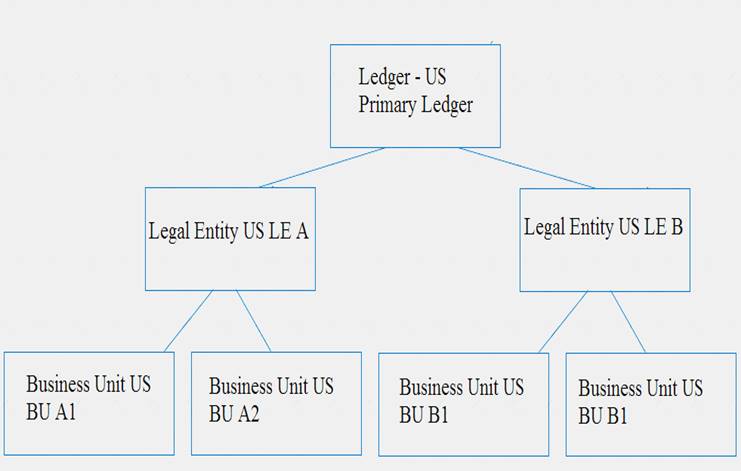
They have completed development work and now want to move all configurations along with data to the next instance related to US LE B only, all Business Units perform Financial transactions.
How can this be achieved?
- A. While you export, set scope values as US LE A and US LE B, and while you import, set scope as Ledger, US Primary Ledge.
- B. While you export, select tasks related to US BU B1 and US BU B2 only.
- C. Export everything and while you import, select scope values for US LE A, US BU B1 and US BU B2.
- D. While you export, set scope values for US LE B and while you import, it will automatically consider data corresponding to Legal Entity US LE B.
Answer: A
NEW QUESTION 17
Your customer wants to enforce required attributes at each stage for certain departments and each assignee has to provide status of their work.
What is the appropriate design approach you propose to accomplish these requirements?
- A. Configure New Item Request to capture required attributes.
- B. Configure Change Order (with revision) with additional steps to capture required attributes.
- C. Configure New Item Request with additional steps to capture required attributes.
- D. Configure Change Order (with no revision) with additional steps to capture required attributes.
- E. Configure Commercial Change Order with additional steps to capture required attributes
Answer: B
NEW QUESTION 18
When creating style and SKU items, your customer wants to manage some attributes at both the style and SKU levels, and manage the remaining attributes only at the style level.
Identify the two setups that are required in the attribute group definitions in order to fulfill this requirement.
- A. For attribute groups to be managed both at the style and SKU levels, set the Style to SKU field to Inherited in the context usage.
- B. For attribute groups to be managed both at the style level, set the Style to SKU field to Defaulted in the context usage.
- C. For attribute groups to be managed both at the style and SKU levels, set the Style to SKU field to Defaulted in the context usage.
- D. For attribute groups to be managed only at the style level, set the Style to SKU field to Inherited in the context usage.
- E. For attribute groups to be managed only at the style level, set the Style to SKU field to None in the context usage.
Answer: CD
NEW QUESTION 19
What are the three options that you select in Oracle Product Hub Cloud to publish objects to a spoke system?
- A. Item Classes
- B. Item Relationships
- C. Item Cross Reference
- D. Items
- E. Item Catalogs
Answer: ADE
Explanation:
Reference https://docs.oracle.com/cd/E51367_01/scmop_gs/FAPIM/F1176849AN22FB3.htm
NEW QUESTION 20
One of your customer employees is assigned as an application administrator. What three functions can the employee perform using Security Console?
- A. Assign Roles to users
- B. Create customers
- C. Create Items
- D. Perform role analysis
- E. Manage users
Answer: BCD
NEW QUESTION 21
You are using “Import Oracle Fusion Data Extensions for Transactional Business Intelligence” job. What changes would be imported when the job completes with a status of Succeeded?
- A. only Descriptive Flexfield changes
- B. seeded Flexfield changes
- C. Key Flexfield, Descriptive Flexfield, and Extensible Flexfield changes
- D. only Key Flexfield and Descriptive Flexfield changes
Answer: C
Explanation:
Reference https://docs.oracle.com/cd/E48434_01/fusionapps.1118/e49138/frameset.htm?ch02s03s06s01.htm
NEW QUESTION 22
......
100% Valid and Newest Version 1z0-1016 Questions & Answers shared by Certifytools, Get Full Dumps HERE: https://www.certifytools.com/1z0-1016-exam.html (New 72 Q&As)
- Highest Quality 1Z0-066 Braindumps 2021
- What Verified 1z0-1008 Exam Prep Is
- Oracle 1z0-1052 Guidance 2021
- Approved 1z0-900 Guidance 2021
- Avant-garde 1Z0-144 Answers 2021
- 100% Correct Oracle 1z0-1003-20 Answers Online
- How Many Questions Of 1z0-1003-20 Questions Pool
- What High Quality 1Z0-344 Exam Question Is
- Top Tips Of Most Recent 1z0-1005 Pdf
- Avant-garde Oracle 1Z0-447 exam dumps