

70-537 Exam Questions - Online Test
70-537 Premium VCE File

150 Lectures, 20 Hours
Our pass rate is high to 98.9% and the similarity percentage between our 70-537 Free Practice Questions and real exam is 90% based on our seven-year educating experience. Do you want achievements in the Microsoft 70-537 exam in just one try? I am currently studying for the 70-537 Braindumps. Latest 70-537 Dumps, Try Microsoft 70-537 Brain Dumps First.
Check 70-537 free dumps before getting the full version:
NEW QUESTION 1
You have an Azure Stack integrated system.
You establish a PowerShell session to a privileged endpoint, and you run several commands. You need to ensure that logs of the session activity are exported to a file share.
Which cmdlet should you run?
- A. Exit
- B. Clear-Host
- C. Out-Default
- D. Close-PrivilegedEndpoint
- E. Exit-PSSession
Answer: D
Explanation: The privileged endpoint logs every action (and its corresponding output) that you perform in the PowerShell session. You must close the session by using the Close-PrivilegedEndpoint cmdlet. This cmdlet correctly closes the endpoint, and transfers the log files to an external file share for retention. Incorrect Answers:
A, E: If you close the privileged endpoint session by using the cmdlets Exit-PSSession or Exit, or you just close the PowerShell console, the transcript logs do not transfer to a file share. They remain in the privileged endpoint. The next time you run Close-PrivilegedEndpoint and include a file share, the transcript logs from the previous session(s) will also transfer.
References: https://docs.microsoft.com/en-us/azure/azure-stack/azure-stack-privileged-endpoint#close-the-privileged-endpoint-session
NEW QUESTION 2
NOTE: This question is part of a series of questions that present the same scenario. Each question in the series contains a unique solution that might meet the stated goals. Some question sets might have more than one correct solution, while others might not have a correct solution.
After you answer a question in this section, you will NOT be able to return to it. As a result, these questions will not appear in the review screen.
You have an Azure Stack integrated system that contains four nodes named Node1, Node2, Node3 and Node4.
You plan to replace Node2.
You need to drain the active workloads that run on Node2.
Solution: From the hardware lifecycle host, you run the Disable-AzsScaleUnitNode cmdlet. Does this meet the goal?
- A. Yes
- B. No
Answer: A
Explanation: The Drain action evacuates all active workloads by distributing them among the remaining nodes in that particular scale unit.
To run the drain action through PowerShell, use the Disable-AzsScaleUnitNode cmdlet. References: https://docs.microsoft.com/en-us/azure/azure-stack/azure-stack-replace-node
NEW QUESTION 3
DRAG DROP
Note: This question is part of a series of questions that use the same scenario. For your convenience, the scenario is repeated in each question. Each question presents a different goal and answer choices, but the text of the scenario is exactly the same in each question in this series.
Start of repeated scenario.
Your company has a network that contains an Active Directory forest named fabrikam.com. The forest is synchronized to a Microsoft Azure Active Directory (Azure AD) tenant and has an Azure subscription.
The company also has an Azure AD tenant named contoso.com. Contoso.com has an Azure subscription. Contoso.com includes foreign principals.
The network contains the computers configured as shown in the following table.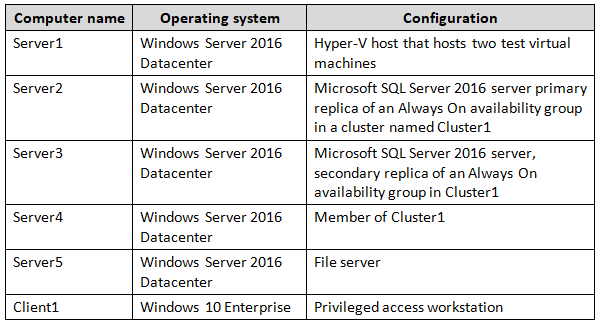
Fabrikam.com contains a user named User1.
For operating system deployment, the company uses a custom operating system image of Windows Server 2021 Datacenter named Image1.
You have an Azure Stack integrated system that is accessed by using the following endpoints: https://portal.fabrikam.com
https://adminportal.fabrikam.com https://management.fabrikam.com Privileged endpoint: 192.168.100.100 Hardware lifecycle host: 192.168.101.101 https://adminmanagement.fabrikam.com
You onboard contoso.com as a guest directory tenant on the Azure Stack integrated system. You implement in the following Azure Stack providers:
SQL Server App Service
End of repeated scenario.
You need to ensure that tenants can use Image1 to deploy virtual machines.
Which three actions should you perform from https://adminportal.fabrikam.com in sequence? To answer, move the appropriate actions from the list of actions to the answer area and arrange them in the correct order.
Answer:
Explanation: 
NEW QUESTION 4
DRAG DROP
Note: This question is part of a series of questions that use the same scenario. For your convenience, the scenario is repeated in each question. Each question presents a different goal and answer choices, but the text of the scenario is exactly the same in each question in this series.
Start of repeated scenario.
Your company has a main office in New York and a branch office in Toronto. Each office has a dedicated connection to the Internet. Each office has a firewall that uses inbound and outbound rules.
The company has an on-premises network that contains several datacenters. The datacenters contain multiple hypervisor deployments, including Window Server 2021 Hyper-V. The network uses Microsoft System Center for monitoring and Windows Azure Pack for self-service.
The company has a Microsoft Azure subscription that contains several workloads. You use Azure Resource Manager templates and other automated processes to create and manage the resources in Azure.
You have an Azure Stack integrated system in the New York office. The company has a deployment team in the Toronto office and a development team in the New York office. The system has an offer named Offer1. Several tenants have subscriptions based on Offer1.
You have a Hyper-V host named Server1 that runs Windows Server 2012 R2. Server1 is used for testing. The hardware on Server1 can support the deployment of the Azure Stack Development Kit. You have a Generation 1 virtual machine named VM1 that runs Windows Server 2012 R2. VM1 is deployed to a Hyper-V host that runs Windows Server 2021. VM1 has a fixed size disk named VM1.vhdx that is 200 GB.
End of repeated scenario.
You need to deploy the Azure Stack Deployment Kit to Server1 to meet the following requirements: Implement the solution as quickly as possible.
Enable the syndication of Azure Marketplace items.
Ensure that the deployment is isolated from the existing environment.
Which four actions should you perform in sequence? To answer, move the appropriate actions from the list of actions to the answer area and arrange them in the correct order.
NOTE: More than one order of answer choices is correct. You will receive credit for any of the correct orders you select.
Answer:
Explanation: 
NEW QUESTION 5
You plan to create a Linux virtual machine on an Azure Stack integrated system.
You download an Ubuntu Server image.
Which authentication method can use to access the Linux virtual machine by using SSH?
- A. a service principal
- B. Microsoft Hello for Business
- C. a password
- D. OAutn
Answer: C
NEW QUESTION 6
You have an Azure Stack integrated system that uses Microsoft Azure Active Directory (Azure AD) for authentication. The system uses an external domain named cloud.contoso.com.
You plan to provide tenant users with the ability to provision App Services and to use Kudu to develop the App Services.
You need to create the Azure AD application for the planned deployment. What should you do?
- A. Run the Add-AzsRegistration cmdle
- B. From https://portal.cloud.contoso.com, create an App Service offer.
- C. Run the Create-AADIdentityApp.ps1 scrip
- D. From https://portal.azure.com, modify the permissions of the Azure AD application.
- E. Run the Add-AzsRegistration cmdle
- F. From https://portal.azure.com, create a new App Service Environment.
- G. Run the Create-AADIdentityApp.ps1 scrip
- H. From https://portal.cloud.contoso.com, create an App Service offer.
Answer: D
NEW QUESTION 7
Note: This question is part of a series of questions that use the same scenario. For your convenience, the scenario is repeated in each question. Each question presents a different goal and answer choices, but the text of the scenario is exactly the same in each question in this series.
Start of repeated scenario.
Your company has a network that contains an Active Directory forest named fabrikam.com. The forest is synchronized to a Microsoft Azure Active Directory (Azure AD) tenant and has an Azure subscription.
The company also has an Azure AD tenant named contoso.com. Contoso.com has an Azure subscription. Contoso.com includes foreign principals.
The network contains the computers configured as shown in the following table.
Fabrikam.com contains a user named User1.
For operating system deployment, the company uses a custom operating system image of Windows Server 2021 Datacenter named Image1.
You have an Azure Stack integrated system that is accessed by using the following endpoints: https://portal.fabrikam.com
https://adminportal.fabrikam.com
https://management.fabrikam.com Privileged endpoint: 192.168.100.100 Hardware lifecycle host: 192.168.101.101 https://adminmanagement.fabrikam.com
You onboard contoso.com as a guest directory tenant on the Azure Stack integrated system. You implement in the following Azure Stack providers:
SQL Server App Service
End of repeated scenario.
You need to ensure that all the services hosted in Azure Stack can resolve the names configured in contoso.com.
Which cmdlet should you run?
- A. Add-DnsServerConditionalForwarderZone
- B. New-AzureRmDnsZone
- C. Register-CustomDnsServer
- D. Set-AzureRmDnsRecordSet
Answer: C
Explanation: References:
https://docs.microsoft.com/en-us/azure/azure-stack/azure-stack-integrate-dns
NEW QUESTION 8
You have two Azure Stack integrated systems named Stack1 and Stack2.
You create an Azure Resource Manager template that successfully deploys to Stack1. You attempt to deploy the template to Stack2, but the deployment fails.
What is a possible cause of the deployment failure?
- A. The template was created by using Microsoft Visual Studio Code.
- B. The template was deployed to Stack2 by using Microsoft Visual Studio.
- C. Stack 1 has Azure Marketplace syndication enabled and Stack2 has Azure Marketplace syndication disabled.
- D. The API version used in the template is a later version than the API version available on Stack2.
Answer: D
Explanation: References: https://docs.microsoft.com/en-us/azure/azure-stack/user/azure-stack-considerations#version-requirements
NEW QUESTION 9
You have an Azure Stack integrated system that has 100 tenants. You create a new offer that is Private.
You need to provide the offer to a tenant. What should you do?
- A. Delegate rights to the tenant user, and then instruct the tenant user to create a new subscription.
- B. Create a new subscription, and then assign the subscription to the tenant.
- C. Run the New-AzsOffer cmdlet, and then specify the tenant user account.
- D. Run the Set-AzsUserSubscription cmdlet, and then specify the subscription of the tenant user.
Answer: B
Explanation: When you create an offer, you must include at least one base plan, but you can also create add-on plans that users can add to their subscription. A subscription is how users access your offers.
After you create an offer, users need a subscription to that offer before they can use it.
You can create subscriptions for both public and private offers. If do not want your tenants to create their own subscriptions, make all of your offers private, and then create subscriptions on behalf of your tenants. This approach is common when integrating Azure Stack with external billing or service catalog systems.
After you create a subscription for a user, that user can log into the user portal and will find that they are subscribed to the offer.
Incorrect Answers:
A: As the Azure Stack operator, you can delegate the creation of offers and users to other users by using the delegation functionality.
C: The New-AzsOffer cmdlet creates an offer composing of the specified base plans and add-on plans.
D: The Set-AzsSubscription cmdlet modifies the current logged-in user's tenant subscription. References:
https://docs.microsoft.com/en-us/azure/azure-stack/azure-stack-delegated-provider https://docs.microsoft.com/en-za/powershell/module/azurerm.azurestackadmin/new-azsoffer?view=azurestackps-1.2.11
https://docs.microsoft.com/en-za/powershell/module/azurerm.azurestackadmin/set-azssubscription?view=azurestackps-1.2.11
https://docs.microsoft.com/en-us/azure/azure-stack/azure-stack-subscribe-plan-provision-vm
NEW QUESTION 10
NOTE: This question is part of a series of questions that present the same scenario. Each question in the series contains a unique solution that might meet the stated goals. Some question sets might have more than one correct solution, while others might not have a correct solution.
After you answer a question in this section, you will NOT be able to return to it. As a result, these questions will not appear in the review screen.
You have an Azure Stack integrated system that contains four nodes named Node1, Node2, Node3 and Node4.
You plan to replace Node2.
You need to drain the active workloads that run on Node2.
Solution: From the hardware lifecycle host, you run the Stop-AzsScaleUnitNode cmdlet. Does this meet the goal?
- A. Yes
- B. No
Answer: B
Explanation: The Drain action evacuates all active workloads by distributing them among the remaining nodes in that particular scale unit.
To run the drain action through PowerShell, use the Disable-AzsScaleUnitNode cmdlet. Incorrect Answers:
A: The Stop-AzsScaleUnitNode cmdlet turns off the node. It’s the same as if you press the power button. It does not send a shutdown signal to the operating system. For planned power off operations, make sure you drain a scale unit node first.
References: https://docs.microsoft.com/en-us/azure/azure-stack/azure-stack-replace-node
NEW QUESTION 11
Note: This question is part of a series of questions that use the same scenario. For your convenience, the scenario is repeated in each question. Each question presents a different goal and answer choices, but the text of the scenario is exactly the same in each question in this series.
Start of repeated scenario.
Your network contains an Active Directory forest named contoso.com
You deploy an Azure Stack integrated system named Prod to a production environment. You also deploy an Azure Stack integrated system named Dev to a development environment. The developers who access Dev change frequently.
The Azure Stack integrated systems and the contoso.com forest are federated.
The on-premises network contains a Hyper-V host that hosts a Red Hat Enterprise Linux virtual machine named Linux1. Linux1 has the following characteristics:
A 2-TB disk Generation 1
10 virtual cores 128 GB of RAM
A disk named LinuxVhd.vhdx
You plan to deploy infrastructure as a service (IaaS) to Dev for developer projects. The Marketplace on Dev is configured and ready to publish items. Dev contains one plan named Dev_Plan1 and one offer named Dev_Offer1.
Prod contains two plans and two offers. One of the offers is named Offer1.
All the IaaS and platform as a service (PaaS) tenant data must be backed up to an external location. The solution must ensure that the data can be restored if the datacenter that hosts Prod becomes unavailable.
End of repeated scenario.
You need to ensure that the team that supports the developers can perform Azure Stack operator tasks on Dev. The solution must minimize the amount of administrative effort required to manage
the administrative rights.
Which three actions should you perform? Each correct answer presents part of the solution.
- A. From the Azure Stack administrator portal, configure the Default Provider Subscription.
- B. In contoso.com, modify the group membership of the development users.
- C. From the Azure Stack administrator portal, create a new subscription.
- D. From PowerShell, run the New-CloudAdminUser cmdlet.
- E. From the Azure Stack administrator portal, create a new resource group.
Answer: ABD
NEW QUESTION 12
NOTE: This question is part of a series of questions that present the same scenario. Each question in the series contains a unique solution that might meet the stated goals. Some question sets might have more than one correct solution, while others might not have a correct solution.
After you answer a question in this section, you will NOT be able to return to it. As a result, these
questions will not appear in the review screen.
You have an Azure Stack integrated system that contains four nodes named Node1, Node2, Node3 and Node4.
You plan to replace Node2.
You need to drain the active workloads that run on Node2.
Solution: From Node1, you run the Repair-AzsScaleUnitNode cmdlet. Does this meet the goal?
- A. Yes
- B. No
Answer: B
Explanation: The Drain action evacuates all active workloads by distributing them among the remaining nodes in that particular scale unit.
To run the drain action through PowerShell, use the Disable-AzsScaleUnitNode cmdlet. Incorrect Answers:
A: The Repair-AzsScaleUnitNode cmdlet repairs the node. It does not drain the node. References: https://docs.microsoft.com/en-us/azure/azure-stack/azure-stack-replace-node
NEW QUESTION 13
HOTSPOT
You have an Azure Stack integrated system.
You need to install the Azure Stack-compatible Azure PowerShell modules on a management workstation.
You set the $profile variable to the correct API version.
Which commands should you run? To answer, select the appropriate options in the answer area. NOTE: Each correct selection is worth one point.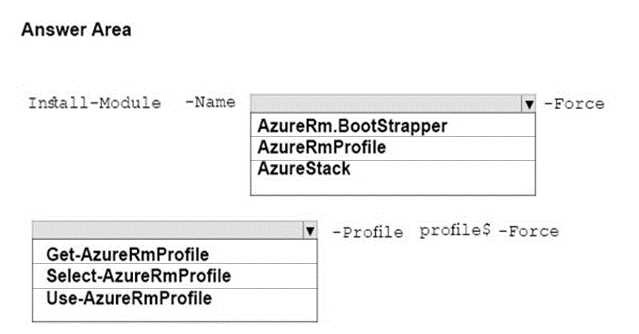
Answer:
Explanation: 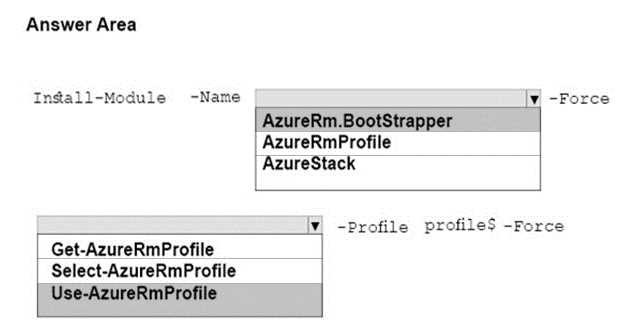
NEW QUESTION 14
You have an Azure Stack integrated system that uses Microsoft Azure Active Directory (Azure AD) for authentication. You download and extract the Azure App Service files.
You need to configure the system to support the deployment of Node.js applications and Azure functions. What should you do before you configure the resource provider?
- A. Install certificate
- B. Register a service principa
- C. Deploy and configure a Microsoft SQL serve
- D. Create a relying party trust.
- E. Install certificate
- F. Deploy and configure a file serve
- G. Deploy and configure a Microsoft SQL serve
- H. Create an Azure AD application.
- I. Install certificate
- J. Register a service principa
- K. Deploy and configure a file serve
- L. Create a relying party in.
- M. Register a service principa
- N. Deploy and configure a file serve
- O. Implement and configure a MySQL resource provide
- P. Configure the Azure functions.
Answer: B
Explanation: Incorrect Answers:
A, C: App Service on Azure Stack does not require a service principal or a relying party trust, but does require Microsoft SQL server for the App Service databases.
D: App Service on Azure Stack requires certificates and Microsoft SQL server for the App Service databases.
References: https://docs.microsoft.com/en-us/azure/azure-stack/azure-stack-app-service-before- you-get-started
NEW QUESTION 15
You manage an Azure Stack integrated system.
You plan to query the usage data of Azure Stack.
Which three parameters can you use in the query? Each correct answer presents a complete solution.
Note: select: Each correct selection is worth one point.
- A. usageEndtinme
- B. meterId
- C. reporttedStarttime
- D. usageStartime
- E. aggregationGranularity
- F. reportedEndtime
Answer: ACF
NEW QUESTION 16
HOTSPOT
You need to retrieve the system logs and the event logs from only the hosts in an Azure Stack integrated system.
Which command should you run? To answer, select the appropriate options in the answer area. NOTE: Each correct selection is worth one point.
Answer:
Explanation: References:
https://docs.microsoft.com/en-us/azure/azure-stack/azure-stack-diagnostics
Thanks for reading the newest 70-537 exam dumps! We recommend you to try the PREMIUM Surepassexam 70-537 dumps in VCE and PDF here: https://www.surepassexam.com/70-537-exam-dumps.html (90 Q&As Dumps)
- Top Quality AZ-102 Exam Questions 2021
- 10 Tips For Rebirth 70-534 exam
- Replace Microsoft 70-413 exam question
- Renewal 70-532 Exam Study Guides With New Update Exam Questions
- 10 Tips For Far out 70-410 exam dumps
- Microsoft 70-333 Study Guides 2021
- Refined 70-742 Study Guides 2021
- Improved MB6-894 Rapidshare 2021
- Practical 70-742 Exam Dumps 2021
- Microsoft 70-475 Braindumps 2021