

1z0-083 Exam Questions - Online Test
1z0-083 Premium VCE File

150 Lectures, 20 Hours

Cause all that matters here is passing the Oracle 1z0-083 exam. Cause all that you need is a high score of 1z0-083 Oracle Database Administration II exam. The only one thing you need to do is downloading Exambible 1z0-083 exam study guides now. We will not let you down with our money-back guarantee.
Oracle 1z0-083 Free Dumps Questions Online, Read and Test Now.
NEW QUESTION 1
Examine this configuration: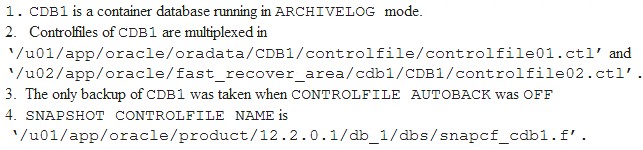
WhileCDB1is open,‘/u02/app/oracle/fast_recover_area/cdb1/CDB1/controlfile02.ctl’is accidentally deleted. To recover from this critical failure, you execute these commands: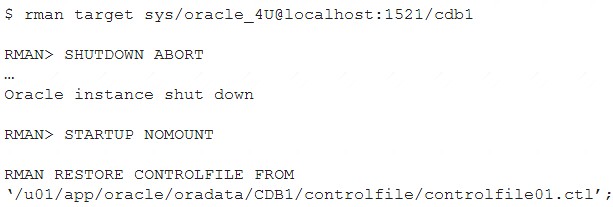
What will be the outcome?
- A. It will create ‘$ORACLE_HOME/dbs/cdb1/CDB1/controlfile02.ctl’
- B. It will create ‘/u01/app/oralce/oradata/CDB1/controlfile/controlfile02.ctl’.
- C. It will re-create ‘/u02/app/oracle/fast_recover_area/cdb1/CDB1/controlfile02.ctl’
- D. It will create ‘/u01/app/oracle/product/12.2.0.1/db_1/dbs/snapcf_cdb1control02.ctl’.
- E. It will fail because there is no autobackup of the controlfiles.
Answer: C
NEW QUESTION 2
Which two are true about RMAN backups when using a media manager to write backups to tape when there are only two tape drives? (Choose two.)
- A. SBT tape compression can be used even if no RMAN compression is configured.
- B. Any backup set written to the SBT device in this configuration can contain a maximum of two backup pieces.
- C. Any backup written to the SBT device in this configuration can contain a maximum of two backup sets.
- D. SBT tape compression and RMAN backup compression should be used in parallel.
- E. The SBT device should be configured to use PARALLELISM 2 to allow both tape drive to be used simultaneously.
Answer: DE
NEW QUESTION 3
Which three are true about monitoring waits for sessions and services? (Choose three.)
- A. V$SESSION_EVENT displays all waits for all past and existing sessions if the wait has occurred at least once for a session.
- B. V$SERVICE_EVENT displays all waits for all services if the wait has occurred at least once for a service.
- C. V$SESSION_WAIT_CLASS displays waits broken down by wait class only for waiting sessions.
- D. V$SESSION_WAIT and V$SESSION both contain details of the event on which a non-waiting session last waited.
- E. V$SESSION_EVENT displays all waits for all past sessions if the wait has occurred at least once for a session.
- F. V$SESSION_WAIT and V$SESSION both contain details of the event on which a session is currently waiting.
Answer: BDE
NEW QUESTION 4
Which two are true about SQL Performance Analyzer (SPA)? (Choose two.)
- A. It is integrated with the SQL Access Advisor.
- B. It predicts the impact of system changes on SQL workloadresponse time.
- C. It provides before and after execution statistics for each SQL statement in the analysis task
- D. It offers fine-grained analysis of all the SQL statements in the analysis task as a group.
- E. SQL statements that were originally run concurrently are run concurrently by SPA.
Answer: BD
NEW QUESTION 5
Which four are true about a Recovery Manager (RMAN)duplication without a TARGET connection? (Choose four.)
- A. The NOREDO clause must be used if the backups of the database being duplicated were taken when the database was in NOARCHIVELOG mode.
- B. The UNDO TABLESPACE clause is always required when no connection exists to the TARGET instance.
- C. RMAN “pushes” the backups of the database to be duplicated over the network to the auxiliary instance.
- D. The NOREDO clause can be used if the backups of the database being duplicated were taken when the database wasin ARCHIVELOG mode.
- E. RMAN SBT-based backups of the database to be duplicated can be used by the auxiliary instance.
- F. The UNDO TABLESPACE clause is always required when no connection exists to the recovery catalog and the TARGET database is closed.
- G. The UNDO TABLESPACE clause is always required when no connection exists to the recovery catalog and the TARGET database is opened.
- H. RMAN disk-based backups of the database to be duplicated can be used by the auxiliary instance.
Answer: ABGH
NEW QUESTION 6
For which two requirements can you use the USER_TABLESPACE clause with the CREATE PLUGGABLE DATABASE command? (Choose two.)
- A. to specify a default tablespace in a PDB cloned from another PDB in the same CDB.
- B. to exclude all tablespaces except SYSTEM, SYSAUX, and TEMPwhen plugging in a PDB
- C. to include specific user tablespaces only when relocating a PDB
- D. to specify the list of user tablespaces to include when moving a non-CDB to a PDB
- E. to exclude a temp tablespace when plugging in a PDB
- F. to specify the list oftablespaces to include when creating a PDB from the CDB seed
Answer: BD
NEW QUESTION 7
Which three are true about performing an Oracle Database install on Linux? (Choose three.)
- A. The runfixup.sh script can install missing RPMs.
- B. The Oracle Preinstallation RPM must be used to configure the Oracle database installation owner, the Oracle Inventory group, and an Oracle administrative privileges group.
- C. It allows you to select the languages supported by the Oracledatabase server.
- D. It can be done before installing Grid Infrastructure for a Standalone Server.
- E. The Oracle Preinstallation RPM can be used to configure the Oracle database installation owner, the Oracle Inventory group, and an Oracle administrative privileges group.
- F. It can be done after installing Grid Infrastructure for a Standalone Server.
- G. The Oracle database administrator must be granted access to the root operating system account to tun root privileged scripts.
Answer: CEG
NEW QUESTION 8
Which three are true about Automatic Workload Repository (AWR), Automatic Database Diagnostic Monitor (ADDM), and the Manageability Monitor (MMON) background process? (Choose three.)
- A. ADDM can recommend shrinking the buffer cache.
- B. ADDM can recommend extending the buffer cache.
- C. By default, MMON creates an AWR snapshot every 30 minutes.
- D. ADDM performs itsanalysis only when a DBA requests it.
- E. By default, AWR snapshots are automatically purged after eight days.
- F. AWR snapshots must be deleted when no longer required by ADDM.
Answer: AEF
NEW QUESTION 9
Which three are true about thresholds, metrics, and server-generated alerts? (Choose three.)
- A. All metrics are instance related.
- B. Cleared statefulalerts are displayed by querying DBA_ALERT_HISTORY.
- C. A space usage management alert is automatically cleared after the underlying problem is resolved.
- D. They are generated by SMON when a tablespace is 97% full.
- E. Metrics are statistical counts for aspecific unit.
- F. STATISTICS_LEVEL must be set to ALL to generate alerts.
Answer: BCE
NEW QUESTION 10
Which two are true about RMAN duplexed backup sets? (Choose two.)
- A. A duplexed backup set uses the same number of SBT channels as a non-duplexed backup set for the same number of files.
- B. A non-duplexed backup set written to disk can be duplexed to disk bybacking up the backup set that is already on disk.
- C. A non-duplexed backup set written to SBT can be duplexed to tape by backing up the backup set that is already on tape.
- D. A non-duplexed backup set written to disk can be duplexed to tape by backing upthe backup set that is already on disk.
- E. A non-duplexed backup set written to SBT can be duplexed to disk by backing up the backup set that is already on tape.
- F. A duplexed backup set always uses twice as many SBT channels as a non-duplexedbackup set for the same number of files.
Answer: DF
NEW QUESTION 11
Which three are true about RMAN persistent configuration settings, administration, and their effects? (Choose three.)
- A. A target database’s persistent RMAN configuration settings are always stored in the target’s control file
- B. Backup older than the recovery window retention policy are always deleted automatically if the backup location has insufficient space.
- C. Backups written to the fast recovery area (FRA) that are oboslete based on the redundancy retention policy can be deleted automatically to free space.
- D. The RMAN SHOW ALL command displays only settings with nondefault values.
- E. A target database’s persistent RMAN configuration settings are always synchronized automatically with the RMAN catalog.
- F. The V$RMAN_CONFIGURATION view displays only settings with values that have been modified.
- G. A DBA must specify either a redundancy retention policy or a recovery window retention policy.
Answer: ABF
NEW QUESTION 12
Which three are true about an application container?
- A. It must have an application root PDB.
- B. It can contain multiple applications.
- C. An application PDB can belong to multiple application containers.
- D. Two application containers can share an application seed PDB.
- E. It can contain a single application.
- F. It must have an application seed PDB.
Answer: BDE
NEW QUESTION 13
Your container database, CDB1, has an application container, HR_ROOT, with an application PDB, HR_PDB1.
You have the required privilege to clone HR_PDB1 to container database CDB2, which does not contain HR_ROOT.
Which two are always true? (Choose two.)
- A. CDB1 and CDB2 must be in shared undo mode.
- B. A common user must exist in CDB2 with the CREATE PLUGGABLE DATABASE privilege.
- C. All transactions in HR_PDB1 of CDB1 must commit before the cloning process starts.
- D. Cloning HR_ROOT automatically clones HR_PDB1.
- E. The HR_PDB1 clone created in CDB2 will be in mount state when cloning ends.
Answer: BD
NEW QUESTION 14
Examine this command:
$ rhpctl move database –sourcehome Oracle_home_path –destinationhome Oracle_home_path For which two purposes can you use this command? (Choose two.)
- A. to switch an existing Oracle Database home to anewer release of Oracle software on the same server
- B. to switch to a read-only Oracle home
- C. to switch back to the previous Oracle home as part of a rollback operation
- D. to switch the Oracle Database home when using a centralized Rapid Home Provisioningserver
- E. to switch to a patched Oracle Database home
Answer: CE
Explanation:
You can use rhpctl move gihome command with the same syntax to switch from the current Oracle Grid Infrastructure home to a patched home. The rhpctl command enables you to switch from your current Oracle Grid Infrastructure or Oracle Database home to patched Oracle home so that you can provision the new Oracle home as gold image. You can also use the rhpctl command to switch back to the old Oracle home, if you want to roll back the operation.
NEW QUESTION 15
Which two are true about Oracle Optimizer Statistics, their use, and their collection? (Choose two.)
- A. The number of table rows is considered when evaluating the cost of accessing a table using an index.
- B. Index balanced B*Tree height is considered whenevaluating the cost of using an index.
- C. The Statistics Advisor can help recommend the best way to gather statistics.
- D. Statistics collected using DBMS_STATS always yield the best optimizer result.
- E. The Statistics Advisor generates actions for all recommendations.
Answer: CD
NEW QUESTION 16
Which two are true about Oracle instance recovery? (Choose three.)
- A. Recovery begins from the beginning of the CURRENT redo log group.
- B. Recovery begins from the last checkpoint position that wascalculated by the Database Writer before instance failure.
- C. Recovery begins from the start of any ACTIVE redo log group or the start of the CURRENT log group if no other group is ACTIVE.
- D. Recovery reads redo until the end of the redo threa
- E. SMON rollsback any dead transactions, and then the datanase is opened.
- F. Recovery begins from the last checkpoint position that was recorded in the control file by the checkpoint process (CKPT).
- G. Recovery reads redo until the end of the redo thread, and then opens the databas
- H. SMON then rolls back any dead transactions.
Answer: BDF
NEW QUESTION 17
Which two are true about Recovery Manager (RMAN) diagnostic message output? (Choose two.)
- A. Media Management messages for SBT devices are always written to sbtio.log.
- B. RMAN error stacks should be read from the bottom up as that is the order in which errors are generated.
- C. RMAN error stacks should be read from the top down as that is the order in which errors are generated.
- D. The RMAN LOG command line clause causes output issued during RMAN commandcompilation to bewritten to a log file and to standard output.
- E. The RMAN LOG command line clause causes output issued during RMAN command compilation to be written to a log file only.
- F. Media Management messages for SBT devices are written to an Oracletrace file.
Answer: EF
NEW QUESTION 18
A database is configured in ARCHIVELOG mode.
Full RMAN backups are taken and no backup to trace has been taken of the control file. A media failure has occurred.
In which two scenarios is complete recovery possible? (Choose two.)
- A. when any archived log from, before, or after the most recent backup is corrupt.
- B. after losing all copies of the control file
- C. after losing an archived log from after the most recent backup
- D. after losing an archived log from before the most recent backup
- E. after losing the SYSTEM tablespace
Answer: DE
NEW QUESTION 19
Which three are true In Oracle 19c and later releases?
- A. Tablespaces always remain In read/write mode during transportable tablespace operations.
- B. Simultaneous data pump jobs can be limited at thepluggable database (PDB) level.
- C. Tablespaces never remain In read/write mode during transportable tablespace operations.
- D. An ordinary data pump export of a table with encrypted columns will always encrypt the same columns when imported.
- E. A transportable data pump import can leave a plugged-in tablespace in read-only mode.
- F. A transportable data pump import can leave a plugged-in tablespace In read/write mode.
Answer: ADE
NEW QUESTION 20
Application PDBs, SALES_APP1 and SALES_APP2, must be created and they must access common tables of the SALES_APP application.
Examine these steps:
* 1. Install the SALES_APP application, including the commontables, in the application root.
* 2. Install the SALES_APP application in the application root and the common tables in both the CDB root and the application root.
* 3. Create an application seed.
* 4. Install the SALES_APP application in the application seed.
* 5. Create the SALES_APP1 and SALES_APP2 application PDBs.
* 6. Sync the SALES_APP1 and SALES_APP2 application PDBs with the application root.
* 7. Sync the SALES_APP1 and SALES_APP2 application PDBs with the application seed.
* 8. Sync the application seed withthe application root.
Which are the minimum required steps in the correct sequence?
- A. 3,4,1,6,8
- B. 1,5,6
- C. 1,3,5,6,7
- D. 1,3,5,7
- E. 2,5,6
Answer: B
NEW QUESTION 21
You must transport the UNIVERSITY tablespace from one database to another. The UNIVERSITY tablespace is currently open read/write.
The source and destination platforms have different endian formats. Examine this list of actions:
* 1.Make the UNIVERSITY tablespace read-only on the source system.
* 2. Export the UNIVERSITY tablespace metadata using EXPDP.
* 3. Convert the UNIVERSITY tablespace data fies to the destination platform format using RMAN on the source system.
* 4. Copy the UNIVERSITY tablespace data files to the destination system.
* 5.Copy the Data Pump dump set to the destination system.
* 6. Convert the UNIVERSITY tablespace data files to thedestination platform format using RMAN on the destination system.
* 7. Import the UNIVERSITY tablespace metadata using IMPDP.
* 8. Make the UNIVERSITY tablespace read/write on the destination system.
Which is the minimum number of actions required, in the correct order, to transport the UNIVERSITY tablespace?
- A. 1, 2, 4, 5, 7, 8
- B. 1, 2, 4, 6, 7, 8
- C. 1, 2, 3, 4, 5, 7, 8
- D. 1, 2, 3, 4, 5, 6, 7, 8
- E. 2, 4, 5, 6, 7
Answer: B
NEW QUESTION 22
Examine this configuration: CDB1is a container database. COMMON_USER_PREFIXisC##. PDB1is a pluggable database contained inCDB1. APP1_ROOTis an application container contained inCDB1. APP1_PDB1is an application PDB contained inAPP1_ROOT.
You execute these commands successfully: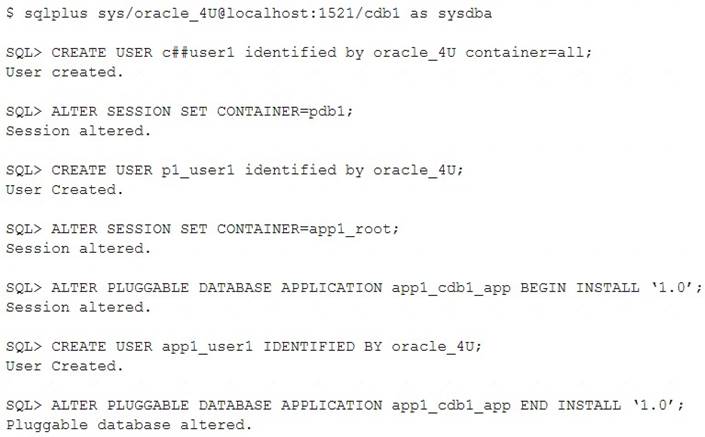
Which two are true? (Choose two.)
- A. APP1_USER1 can be created in PDB1.
- B. APP1_USER1 can be created in CDB1.
- C. APP1_USER1 canhave different privileges in each Application PDB contained in APP1_ROOT.
- D. C##_APP_USER1 can be created in CDB1.
- E. P1_USER1 can be created in CDB1.
- F. C##_USER1 will have the same privileges and roles granted in all PDBs in CDB1.
Answer: CF
NEW QUESTION 23
Which three are true about Audit policies In container databases (CDBs)?
- A. All audit records are written to the audit trail in CDB$ROOT
- B. A common unified audit policy can be created at the application root level.
- C. A common unified audit policy can be created at the CDB level.
- D. An application PDB cannot have a local audit policy.
- E. Fine-grained auditing policies defined in an application root must be manually synchronized by each application PDB contained in the application root.
- F. Application-common unified audit policies defined In an application root must be manually synchronized by each application PDB contained in the application root.
Answer: DEF
NEW QUESTION 24
Examine these actions:
* 1. Create a new database for a recovery catalog.
* 2. Create a tablespace with sufficient space in the catalog database for the recovery catalog.
* 3.Configure ARCHIVELOG mode for the catalog database.
* 4. Create a user to own the recovery catalog schema with quota on the tablespace that will containthe catalog.
* 5. Grant the RECOVERY_CATALOG_OWNER role to the recovery catalog schema owner.
* 6.Grant the SYSBACKUP privilege to the recovery catalog schema owner.
Which are the minimum actions that must be performed before executing the CREATECATALOG command?
- A. 2, 4, 5, 6
- B. 1, 2, 3, 4, 5, 6
- C. 1, 2, 4, 5
- D. 2, 4, 5
- E. 1, 3, 4, 5
Answer: D
NEW QUESTION 25
Which three are true? (Choose three.)
- A. Virtual Private Database (VPD) policies on objects in an application root are automatically synchronized with all application PDBs containedin the application container.
- B. Application-common TSDP policies are always container specific.
- C. Application-common Transparent Security Data Protection (TSDP) policies can be created only within an application install/patch BEGIN-END block.
- D. Application-common Oracle Label Security (OLS) policies cannot be created in an application root outside an install/patch BEGIN-END block.
- E. Fine-grained auditing (FGA) policies in an application root are automatically synchronized to all application PDBs contained in the application container.
- F. Application-common OLS policies can be created in an application root inside an install/patch BEGIN-ENDblock.
- G. Unified auditing can be automatically synchronized to all application PDBs in an applicationcontainer.
Answer: ADG
NEW QUESTION 26
......
100% Valid and Newest Version 1z0-083 Questions & Answers shared by Certshared, Get Full Dumps HERE: https://www.certshared.com/exam/1z0-083/ (New 96 Q&As)
- Breathing 1Z0-053 Braindumps 2021
- Verified 1z0-1054 Braindump 2021
- The Rebirth Guide To 1Z0-821 Test Questions
- All About Accurate 1z0-1085-20 Question
- The Abreast Of The Times Guide To 1z0-1073 Training Tools
- Oracle 1Z0-066 Exam Dumps 2021
- All About Precise 1z0-932 Free Demo
- Oracle 1z0-1001 Braindumps 2021
- Vivid 1z0-1009 Faq 2021
- Oracle 1z0-1023 Training Tools 2021