

SSCP Exam Questions - Online Test
SSCP Premium VCE File

150 Lectures, 20 Hours

Want to know Passleader SSCP Exam practice test features? Want to lear more about ISC2 System Security Certified Practitioner (SSCP) certification experience? Study Best Quality ISC2 SSCP answers to Up to the minute SSCP questions at Passleader. Gat a success with an absolute guarantee to pass ISC2 SSCP (System Security Certified Practitioner (SSCP)) test on your first attempt.
ISC2 SSCP Free Dumps Questions Online, Read and Test Now.
NEW QUESTION 1
Network cabling comes in three flavors, they are:
- A. twisted pair, coaxial, and fiber optic.
- B. tagged pair, coaxial, and fiber optic.
- C. trusted pair, coaxial, and fiber optic.
- D. twisted pair, control, and fiber optic.
Answer: A
Explanation:
Network cabling comes in three flavors: twisted pair, coaxial, and fiber optic. Twisted pair
Twisted pair cabling is a form of wiring in which two wires (the forward and return conductors of a single circuit) are twisted together for the purposes of canceling out electromagnetic interference (EMI) from external sources. This type of cable is used for home and corporate Ethernet networks. Twisted pair cables consist of two insulated copper wires. There are three types of twisted pair cables: Shielded, Unshielded and Foil
Fiber Optic cable
An optical fiber cable consists of a center glass core surrounded by several layers of protective material. The outer insulating jacket is made of Teflon or PVC to prevent interference. It is expensive but has higher bandwidth and can transmit data over longer distances.
Coaxial cable
Coaxial lines confine the electromagnetic wave to area inside the cable, between the center conductor and the shield. The transmission of energy in the line occurs totally through the dielectric inside the cable between the conductors. Coaxial lines can therefore be bent and twisted (subject to limits) without negative effects, and they can be strapped to conductive supports without inducing unwanted currents in them and though.
The most common use for coaxial cables is for television and other signals with bandwidth of multiple megahertz. Although in most homes coaxial cables have been installed for transmission of TV signals, new technologies (such as the ITU-T G.hn standard) open the possibility of using home coaxial cable for high-speed home networking applications (Ethernet over coax).
See the following page for more details: http://fcit.usf.edu/network/chap4/chap4.htm Reference used for this question:
KRUTZ, Ronald L. & VINES, Russel D., The CISSP Prep Guide: Mastering the Ten Domains of Computer Security, 2001, John Wiley & Sons, Page 101.
and
Wikipedia at http://en.wikipedia.org/wiki/Networking_cables
NEW QUESTION 2
Which of the following is NOT a defined ISO basic task related to network management?
- A. Fault management
- B. Accounting resources
- C. Security management
- D. Communications management
Answer: D
Explanation:
ISO has defined five basic tasks related to network management :
Fault management: Detects the devices that present some kind of fault. Configuration management: Allows users to know, define and change remotely the configuration of any device.
Accounting resources: Holds the records of the resource usage in the WAN. Performance management: Monitors usage levels and sets alarms when a threshold has been surpassed.
Security management: Detects suspicious traffic or users and generates alarms accordingly.
Source: Information Systems Audit and Control Association, Certified Information Systems Auditor 2002 review manual, Chapter 3: Technical Infrastructure and Operational Practices (page 137).
NEW QUESTION 3
Which of the following ciphers is a subset on which the Vigenere polyalphabetic cipher was based on?
- A. Caesar
- B. The Jefferson disks
- C. Enigma
- D. SIGABA
Answer: A
Explanation:
In cryptography, a Caesar cipher, also known as Caesar's cipher, the shift cipher, Caesar's code or Caesar shift, is one of the simplest and most widely known encryption techniques. It is a type of substitution cipher in which each letter in the plaintext is replaced by a letter some fixed number of positions down the alphabet. For example, with a left shift of 3, D would be replaced by A, E would become B, and so on. The method is named after Julius Caesar, who used it in his private correspondence.
The encryption step performed by a Caesar cipher is often incorporated as part of more complex schemes, such as the Vigen??re cipher, and still has modern application in the ROT13 system. As with all single alphabet substitution ciphers, the Caesar cipher is easily broken and in modern practice offers essentially no communication security.
The following answer were incorrect:
The Jefferson disk, or wheel cipher as Thomas Jefferson named it, also known as the Bazeries Cylinder, is a cipher system using a set of wheels or disks, each with the 26 letters of the alphabet arranged around their edge. The order of the letters is different for each disk and is usually scrambled in some random way. Each disk is marked with a unique number. A hole in the centre of the disks allows them to be stacked on an axle. The
disks are removable and can be mounted on the axle in any order desired. The order of the disks is the cipher key, and both sender and receiver must arrange the disks in the same predefined order. Jefferson's device had 36 disks.
An Enigma machine is any of a family of related electro-mechanical rotor cipher machines used for the encryption and decryption of secret messages. Enigma was invented by the German engineer Arthur Scherbius at the end of World War I. The early models were used commercially from the early 1920s, and adopted by military and government services of several countries. Several different Enigma models were produced, but the German military models are the ones most commonly discussed.
SIGABA: In the history of cryptography, the ECM Mark II was a cipher machine used by the United States for message encryption from World War II until the 1950s. The machine was also known as the SIGABA or Converter M-134 by the Army, or CSP-888/889 by the Navy, and a modified Navy version was termed the CSP-2900. Like many machines of the era it used an electromechanical system of rotors in order to encipher messages, but with a number of security improvements over previous designs. No successful cryptanalysis of the machine during its service lifetime is publicly known.
Reference(s) used for this question: http://en.wikipedia.org/wiki/Jefferson_disk
http://en.wikipedia.org/wiki/Sigaba http://en.wikipedia.org/wiki/Enigma_machine
NEW QUESTION 4
Which of the following is an example of an active attack?
- A. Traffic analysis
- B. Scanning
- C. Eavesdropping
- D. Wiretapping
Answer: B
Explanation:
Scanning is definitively a very active attack. The attacker will make use of a scanner to perform the attack, the scanner will send a very large quantity of packets to the target in order to illicit responses that allows the attacker to find information about the operating system, vulnerabilities, misconfiguration and more. The packets being sent are sometimes attempting to identify if a known vulnerability exist on the remote hosts.
A passive attack is usually done in the footprinting phase of an attack. While doing your passive reconnaissance you never send a single packet to the destination target. You gather information from public databases such as the DNS servers, public information through search engines, financial information from finance web sites, and technical infomation from mailing list archive or job posting for example.
An attack can be active or passive.
An "active attack" attempts to alter system resources or affect their operation.
A "passive attack" attempts to learn or make use of information from the system but does not affect system resources. (E.g., see: wiretapping.)
The following are all incorrect answers because they are all passive attacks:
Traffic Analysis - Is the process of intercepting and examining messages in order to deduce information from patterns in communication. It can be performed even when the messages are encrypted and cannot be decrypted. In general, the greater the number of messages observed, or even intercepted and stored, the more can be inferred from the traffic. Traffic analysis can be performed in the context of military intelligence or counter-intelligence, and is a concern in computer security.
Eavesdropping - Eavesdropping is another security risk posed to networks. Because of the way some networks are built, anything that gets sent out is broadcast to everyone. Under normal circumstances, only the computer that the data was meant for will process that information. However, hackers can set up programs on their computers called "sniffers" that capture all data being broadcast over the network. By carefully examining the data, hackers can often reconstruct real data that was never meant for them. Some of the most damaging things that get sniffed include passwords and credit card information.
In the cryptographic context, Eavesdropping and sniffing data as it passes over a network are considered passive attacks because the attacker is not affecting the protocol, algorithm, key, message, or any parts of the encryption system. Passive attacks are hard to detect, so in most cases methods are put in place to try to prevent them rather than to detect and stop them. Altering messages, modifying system files, and masquerading as another individual are acts that are considered active attacks because the attacker is actually doing something instead of sitting back and gathering data. Passive attacks are usually used to gain information prior to carrying out an active attack."
Wiretapping - Wiretapping refers to listening in on electronic communications on
telephones, computers, and other devices. Many governments use it as a law enforcement tool, and it is also used in fields like corporate espionage to gain access to privileged information. Depending on where in the world one is, wiretapping may be tightly controlled with laws that are designed to protect privacy rights, or it may be a widely accepted practice with little or no protections for citizens. Several advocacy organizations have been established to help civilians understand these laws in their areas, and to fight illegal wiretapping.
Reference(s) used for this question:
HARRIS, Shon, All-In-One CISSP Certification Exam Guide, 6th Edition, Cryptography,
Page 865 and
http://en.wikipedia.org/wiki/Attack_%28computing%29 and
http://www.wisegeek.com/what-is-wiretapping.htm and
https://pangea.stanford.edu/computing/resources/network/security/risks.php and
http://en.wikipedia.org/wiki/Traffic_analysis
NEW QUESTION 5
Which of the following can best eliminate dial-up access through a Remote Access Server as a hacking vector?
- A. Using a TACACS+ server.
- B. Installing the Remote Access Server outside the firewall and forcing legitimate users to authenticate to the firewall.
- C. Setting modem ring count to at least 5.
- D. Only attaching modems to non-networked hosts.
Answer: B
Explanation:
Containing the dial-up problem is conceptually easy: by installing the Remote Access Server outside the firewall and forcing legitimate users to authenticate to the firewall, any access to internal resources through the RAS can be filtered as would any other connection coming from the Internet.
The use of a TACACS+ Server by itself cannot eliminate hacking.
Setting a modem ring count to 5 may help in defeating war-dialing hackers who look for modem by dialing long series of numbers.
Attaching modems only to non-networked hosts is not practical and would not prevent
these hosts from being hacked.
Source: STREBE, Matthew and PERKINS, Charles, Firewalls 24seven, Sybex 2000, Chapter 2: Hackers.
NEW QUESTION 6
Which of the following phases of a software development life cycle normally incorporates the security specifications, determines access controls, and evaluates encryption options?
- A. Detailed design
- B. Implementation
- C. Product design
- D. Software plans and requirements
Answer: C
Explanation:
The Product design phase deals with incorporating security specifications, adjusting test plans and data, determining access controls, design documentation, evaluating encryption options, and verification.
Implementation is incorrect because it deals with Installing security software, running the system, acceptance testing, security software testing, and complete documentation certification and accreditation (where necessary).
Detailed design is incorrect because it deals with information security policy, standards, legal issues, and the early validation of concepts.
software plans and requirements is incorrect because it deals with addressesing threats, vulnerabilities, security requirements, reasonable care, due diligence, legal liabilities, cost/benefit analysis, level of protection desired, test plans.
Sources:
KRUTZ, Ronald L. & VINES, Russel D., The CISSP Prep Guide: Mastering the Ten Domains of Computer Security, John Wiley & Sons, 2001, Chapter 7: Applications and Systems Development (page 252).
KRUTZ, Ronald & VINES, Russel, The CISSP Prep Guide: Gold Edition, Wiley Publishing Inc., 2003, Chapter 7: Security Life Cycle Components, Figure 7.5 (page 346).
145
At which of the basic phases of the System Development Life Cycle are security
requirements formalized?
A. Disposal
B. System Design Specifications
C. Development and Implementation
D. Functional Requirements Definition
Answer: D
During the Functional Requirements Definition the project management and systems development teams will conduct a comprehensive analysis of current and possible future functional requirements to ensure that the new system will meet end-user needs. The teams also review the documents from the project initiation phase and make any revisions or updates as needed. For smaller projects, this phase is often subsumed in the project initiation phase. At this point security requirements should be formalized.
The Development Life Cycle is a project management tool that can be used to plan, execute, and control a software development project usually called the Systems Development Life Cycle (SDLC).
The SDLC is a process that includes systems analysts, software engineers, programmers, and end users in the project design and development. Because there is no industry-wide SDLC, an organization can use any one, or a combination of SDLC methods.
The SDLC simply provides a framework for the phases of a software development project from defining the functional requirements to implementation. Regardless of the method used, the SDLC outlines the essential phases, which can be shown together or as separate elements. The model chosen should be based on the project.
For example, some models work better with long-term, complex projects, while others are more suited for short-term projects. The key element is that a formalized SDLC is utilized.
The number of phases can range from three basic phases (concept, design, and implement) on up.
The basic phases of SDLC are: Project initiation and planning
Functional requirements definition
System design specifications Development and implementation
Documentation and common program controls
Testing and evaluation control, (certification and accreditation) Transition to production (implementation)
The system life cycle (SLC) extends beyond the SDLC to include two additional phases: Operations and maintenance support (post-installation)
Revisions and system replacement
System Design Specifications
This phase includes all activities related to designing the system and software. In this phase, the system architecture, system outputs, and system interfaces are designed. Data input, data flow, and output requirements are established and security features are designed, generally based on the overall security architecture for the company.
Development and Implementation
During this phase, the source code is generated, test scenarios and test cases are developed, unit and integration testing is conducted, and the program and system are documented for maintenance and for turnover to acceptance testing and production. As well as general care for software quality, reliability, and consistency of operation, particular care should be taken to ensure that the code is analyzed to eliminate common vulnerabilities that might lead to security exploits and other risks.
Documentation and Common Program Controls
These are controls used when editing the data within the program, the types of logging the program should be doing, and how the program versions should be stored. A large number of such controls may be needed, see the reference below for a full list of controls.
Acceptance
In the acceptance phase, preferably an independent group develops test data and tests the code to ensure that it will function within the organization??s environment and that it meets all the functional and security requirements. It is essential that an independent group test the code during all applicable stages of development to prevent a separation of duties issue. The goal of security testing is to ensure that the application meets its security requirements and specifications. The security testing should uncover all design and implementation flaws that would allow a user to violate the software security policy and requirements. To ensure test validity, the application should be tested in an environment that simulates the production environment. This should include a security certification package and any user documentation.
Certification and Accreditation (Security Authorization)
Certification is the process of evaluating the security stance of the software or system against a predetermined set of security standards or policies. Certification also examines how well the system performs its intended functional requirements. The certification or evaluation document should contain an analysis of the technical and nontechnical security features and countermeasures and the extent to which the software or system meets the security requirements for its mission and operational environment.
Transition to Production (Implementation)
During this phase, the new system is transitioned from the acceptance phase into the live production environment. Activities during this phase include obtaining security accreditation; training the new users according to the implementation and training schedules; implementing the system, including installation and data conversions; and, if necessary, conducting any parallel operations.
Revisions and System Replacement
As systems are in production mode, the hardware and software baselines should be subject to periodic evaluations and audits. In some instances, problems with the application may not be defects or flaws, but rather additional functions not currently developed in the application. Any changes to the application must follow the same SDLC and be recorded in a change management system. Revision reviews should include security planning and procedures to avoid future problems. Periodic application audits should be conducted and include documenting security incidents when problems occur. Documenting system failures is a valuable resource for justifying future system enhancements.
Below you have the phases used by NIST in it's 800-63 Revision 2 document
As noted above, the phases will vary from one document to another one. For the purpose of the exam use the list provided in the official ISC2 Study book which is presented in short form above. Refer to the book for a more detailed description of activities at each of the phases of the SDLC.
However, all references have very similar steps being used. As mentioned in the official book, it could be as simple as three phases in it's most basic version (concept, design, and implement) or a lot more in more detailed versions of the SDLC.
The key thing is to make use of an SDLC.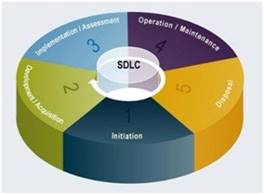
C:\Users\MCS\Desktop\1.jpg SDLC phases
Reference(s) used for this question:
NIST SP 800-64 Revision 2 at http://csrc.nist.gov/publications/nistpubs/800-64-
Rev2/SP800-64-Revision2.pdf and
Schneiter, Andrew (2013-04-15). Official (ISC)2 Guide to the CISSP CBK, Third Edition: Software Development Security ((ISC)2 Press) (Kindle Locations 134-157). Auerbach Publications. Kindle Edition.
NEW QUESTION 7
You are running a packet sniffer on a network and see a packet containing a long string of "0x90 0x90 0x90 0x90...." in the middle of it traveling to an x86-based machine as a target. This could be indicative of what activity being attempted?
- A. Over-subscription of the traffic on a backbone.
- B. A source quench packet.
- C. A FIN scan.
- D. A buffer overflow attack.
Answer: D
Explanation:
A series of the same control characters, hexadecimal code, imbedded in the
string is usually an indicator of a buffer overflow attack.
The Intel x86 processors use the hexadecimal number 90 to represent NOP (no operation). Many buffer overflow attacks use long strings of control characters and this is representative of that type of attack.
A buffer overflow takes place when too much data are accepted as input to a specific process. A buffer is an allocated segment of memory. A buffer can be overflowed arbitrarily with too much data, but for it to be of any use to an attacker, the code inserted into the buffer must be of a specific length, followed up by commands the attacker wants executed. So, the purpose of a buffer overflow may be either to make a mess, by shoving arbitrary data into various memory segments, or to accomplish a specific task, by pushing into the memory segment a carefully crafted set of data that will accomplish a specific task. This task could be to open a command shell with administrative privilege or execute malicious code.
Common threats to system availability, integrity, and confidentiality include hardware failure, misuse of system privileges, buffer overflows and other memory attacks, denial of service, reverse engineering, and system hacking.
Since many vulnerabilities result from insecure design and most threats are well known, it is the responsibility of the security architect to ensure that their designs are addressing security requirements appropriately while also ensuring that the system can continue to perform its intended function.
The following answers are incorrect:
Over-subscription of the traffic on a backbone. Is incorrect because if there was Over- subscription of the traffic on a backbone, that would typically result in not being able to send or receive any packets, more commonly known as Denial of Service or DoS.
A source quench packet. This is incorrect because a source quench packet is an ICMP message that contains the internet header plus 64 bits of the original datagram.
A FIN scan. This is incorrect because a FIN scan is when a packet with the FIN flag set is sent to a specific port and the results are then analyzed.
Reference(s) used for this question:
Harris, Shon (2012-10-25). CISSP All-in-One Exam Guide, 6th Edition, Security Architecture and Design, Page 332, for people using the Kindle edition you will find it at
Kindle Locations 7310-7315.
Schneiter, Andrew (2013-04-15). Official (ISC)2 Guide to the CISSP CBK, Third Edition : Security Architecture and Design (Kindle Locations 1403-1407). . Kindle Edition.
Wikipedia http://en.wikipedia.org/wiki/Port_scanner
ICMP http://security.maruhn.com/iptables-tutorial/x1078.html Wikipedia http://en.wikipedia.org/wiki/Buffer_overflow
NEW QUESTION 8
In a Public Key Infrastructure, how are public keys published?
- A. They are sent via e-mail.
- B. Through digital certificates.
- C. They are sent by owners.
- D. They are not published.
Answer: B
Explanation:
Public keys are published through digital certificates, signed by certification authority (CA), binding the certificate to the identity of its bearer.
A bit more details:
Although ??Digital Certificates?? is the best (or least wrong!) in the list of answers presented, for the past decade public keys have been published (ie: made known to the World) by the means of a LDAP server or a key distribution server (ex.: http://pgp.mit.edu/). An indirect publishing method is through OCSP servers (to validate digital signatures?? CRL)
Reference used for this question:
TIPTON, Hal, (ISC)2, Introduction to the CISSP Exam presentation. and
http://technet.microsoft.com/en-us/library/dd361898.aspx
NEW QUESTION 9
What is called the access protection system that limits connections by calling back the number of a previously authorized location?
- A. Sendback systems
- B. Callback forward systems
- C. Callback systems
- D. Sendback forward systems
Answer: C
Explanation:
The Answer: Call back Systems; Callback systems provide access protection by calling back the number of a previously authorized location, but this control can be compromised by call forwarding.
Source: KRUTZ, Ronald L. & VINES, Russel D., The CISSP Prep Guide: Mastering the Ten Domains of Computer Security, 2001, John Wiley & Sons, Page 35.
NEW QUESTION 10
Which one of the following is used to provide authentication and confidentiality for e-mail messages?
- A. Digital signature
- B. PGP
- C. IPSEC AH
- D. MD4
Answer: B
Explanation:
Instead of using a Certificate Authority, PGP uses a "Web of Trust", where users can certify each other in a mesh model, which is best applied to smaller groups.
In cryptography, a web of trust is a concept used in PGP, GnuPG, and other OpenPGP compatible systems to establish the authenticity of the binding between a public key and its owner. Its decentralized trust model is an alternative to the centralized trust model of a public key infrastructure (PKI), which relies exclusively on a certificate authority (or a hierarchy of such). The web of trust concept was first put forth by PGP creator Phil Zimmermann in 1992 in the manual for PGP version 2.0.
Pretty Good Privacy (PGP) is a data encryption and decryption computer program that provides cryptographic privacy and authentication for data communication. PGP is often used for signing, encrypting and decrypting texts, E-mails, files, directories and whole disk partitions to increase the security of e-mail communications. It was created by Phil Zimmermann in 1991.
As per Shon Harris's book:
Pretty Good Privacy (PGP) was designed by Phil Zimmerman as a freeware e-mail security program and was released in 1991. It was the first widespread public key encryption program. PGP is a complete cryptosystem that uses cryptographic protection to protect e- mail and files. It can use RSA public key encryption for key management and use IDEA symmetric cipher for bulk encryption of data, although the user has the option of picking different types of algorithms for these functions. PGP can provide confidentiality by using the IDEA encryption algorithm, integrity by using the MD5 hashing algorithm, authentication by using the public key certificates, and nonrepudiation by using cryptographically signed messages. PGP initially used its own type of digital certificates rather than what is used in PKI, but they both have similar purposes. Today PGP support X.509 V3 digital certificates.
Reference(s) used for this question:
KRUTZ, Ronald L. & VINES, Russel D., The CISSP Prep Guide: Mastering the Ten Domains of Computer Security, John Wiley & Sons, 2001, Chapter 4: Cryptography (page 169).
Shon Harris, CISSP All in One book https://en.wikipedia.org/wiki/Pretty_Good_Privacy
TIPTON, Hal, (ISC)2, Introduction to the CISSP Exam presentation.
NEW QUESTION 11
In what way could Java applets pose a security threat?
- A. Their transport can interrupt the secure distribution of World Wide Web pages over the Internet by removing SSL and S-HTTP
- B. Java interpreters do not provide the ability to limit system access that an applet could have on a client system.
- C. Executables from the Internet may attempt an intentional attack when they are downloaded on a client system.
- D. Java does not check the bytecode at runtime or provide other safety mechanisms for program isolation from the client system.
Answer: C
Explanation:
Source: TIPTON, Hal, (ISC)2, Introduction to the CISSP Exam presentation.
NEW QUESTION 12
PGP uses which of the following to encrypt data?
- A. An asymmetric encryption algorithm
- B. A symmetric encryption algorithm
- C. A symmetric key distribution system
- D. An X.509 digital certificate
Answer: B
Explanation:
Notice that the question specifically asks what PGP uses to encrypt For this, PGP uses an symmetric key algorithm. PGP then uses an asymmetric key algorithm to encrypt the session key and then send it securely to the receiver. It is an hybrid system where both types of ciphers are being used for different purposes.
Whenever a question talks about the bulk of the data to be sent, Symmetric is always best to choice to use because of the inherent speed within Symmetric Ciphers. Asymmetric ciphers are 100 to 1000 times slower than Symmetric Ciphers.
The other answers are not correct because:
"An asymmetric encryption algorithm" is incorrect because PGP uses a symmetric algorithm to encrypt data.
"A symmetric key distribution system" is incorrect because PGP uses an asymmetric algorithm for the distribution of the session keys used for the bulk of the data.
"An X.509 digital certificate" is incorrect because PGP does not use X.509 digital certificates to encrypt the data, it uses a session key to encrypt the data.
References:
Official ISC2 Guide page: 275
All in One Third Edition page: 664 - 665
NEW QUESTION 13
Which of the following is not a component of a Operations Security "triples"?
- A. Asset
- B. Threat
- C. Vulnerability
- D. Risk
Answer: D
Explanation:
The Operations Security domain is concerned with triples - threats, vulnerabilities and assets.
Source: KRUTZ, Ronald L. & VINES, Russel D., The CISSP Prep Guide: Mastering the Ten Domains of Computer Security, 2001, John Wiley & Sons, Page 216.
NEW QUESTION 14
Which of the following would provide the BEST stress testing environment taking under consideration and avoiding possible data exposure and leaks of sensitive data?
- A. Test environment using test data.
- B. Test environment using sanitized live workloads data.
- C. Production environment using test data.
- D. Production environment using sanitized live workloads data.
Answer: B
Explanation:
The best way to properly verify an application or system during a stress test would be to expose it to "live" data that has been sanitized to avoid exposing any sensitive information or Personally Identifiable Data (PII) while in a testing environment. Fabricated test data may not be as varied, complex or computationally demanding as "live" data. A production environment should never be used to test a product, as a production environment is one where the application or system is being put to commercial or operational use. It is a best practice to perform testing in a non-production environment.
Stress testing is carried out to ensure a system can cope with production workloads, but as it may be tested to destruction, a test environment should always be used to avoid damaging the production environment. Hence, testing should never take place in a production environment. If only test data is used, there is no certainty that the system was adequately stress tested.
NEW QUESTION 15
Which of the following control pairings include: organizational policies and procedures, pre- employment background checks, strict hiring practices, employment agreements, employee termination procedures, vacation scheduling, labeling of sensitive materials, increased supervision, security awareness training, behavior awareness, and sign-up procedures to obtain access to information systems and networks?
- A. Preventive/Administrative Pairing
- B. Preventive/Technical Pairing
- C. Preventive/Physical Pairing
- D. Detective/Administrative Pairing
Answer: A
Explanation:
The Answer: Preventive/Administrative Pairing: These mechanisms include organizational policies and procedures, pre-employment background checks, strict hiring practices, employment agreements, friendly and unfriendly employee termination procedures, vacation scheduling, labeling of sensitive materials, increased supervision, security awareness training, behavior awareness, and sign-up procedures to obtain access to information systems and networks.
Source: KRUTZ, Ronald L. & VINES, Russel D., The CISSP Prep Guide: Mastering the Ten Domains of Computer Security, 2001, John Wiley & Sons, Page 34.
NEW QUESTION 16
Which one of the following statements about the advantages and disadvantages of network-based Intrusion detection systems is true
- A. Network-based IDSs are not vulnerable to attacks.
- B. Network-based IDSs are well suited for modern switch-based networks.
- C. Most network-based IDSs can automatically indicate whether or not an attack was successful.
- D. The deployment of network-based IDSs has little impact upon an existing network.
Answer: D
Explanation:
Network-based IDSs are usually passive devices that listen on a network wire without interfering with the normal operation of a network. Thus, it is usually easy to retrofit a network to include network-based IDSs with minimal effort.
Network-based IDSs are not vulnerable to attacks is not true, even thou network-based IDSs can be made very secure against attack and even made invisible to many attackers they still have to read the packets and sometimes a well crafted packet might exploit or kill your capture engine.
Network-based IDSs are well suited for modern switch-based networks is not true as most switches do not provide universal monitoring ports and this limits the monitoring range of a network-based IDS sensor to a single host. Even when switches provide such monitoring ports, often the single port cannot mirror all traffic traversing the switch.
Most network-based IDSs can automatically indicate whether or not an attack was successful is not true as most network-based IDSs cannot tell whether or not an attack was successful; they can only discern that an attack was initiated. This means that after a network-based IDS detects an attack, administrators must manually investigate each attacked host to determine whether it was indeed penetrated.
Reference:
NIST special publication 800-31 Intrusion Detection System pages 15-16 Official guide to the CISSP CBK. Pages 196 to 197
NEW QUESTION 17
......
P.S. Easily pass SSCP Exam with 1074 Q&As Downloadfreepdf.net Dumps & pdf Version, Welcome to Download the Newest Downloadfreepdf.net SSCP Dumps: https://www.downloadfreepdf.net/SSCP-pdf-download.html (1074 New Questions)
- ISC2 CISSP Braindumps 2021
- Realistic CISSP Dumps 2021
- All About High Value SSCP Test Questions
- Top Tips Of Improved SSCP Free Exam
- The Secret Of ISC2 SSCP Preparation Labs
- ISC2 CISSP Dumps Questions 2021
- ISC2 CCSP Exam Questions and Answers 2021
- High Quality CISSP-ISSAP Study Guides 2021
- Refined CCSP Braindumps 2021
- High quality CCSP Exam Questions and Answers 2021