

DP-201 Exam Questions - Online Test
DP-201 Premium VCE File

150 Lectures, 20 Hours

Simulation of DP-201 test preparation materials and free practice questions for Microsoft certification for IT learners, Real Success Guaranteed with Updated DP-201 pdf dumps vce Materials. 100% PASS Designing an Azure Data Solution exam Today!
Microsoft DP-201 Free Dumps Questions Online, Read and Test Now.
NEW QUESTION 1
A company is evaluating data storage solutions.
You need to recommend a data storage solution that meets the following requirements: Minimize costs for storing blob objects.
Optimize access for data that is infrequently accessed. Data must be stored for at least 30 days.
Data availability must be at least 99 percent. What should you recommend?
- A. Premium
- B. Cold
- C. Hot
- D. Archive
Answer: B
Explanation:
Azure’s cool storage tier, also known as Azure cool Blob storage, is for infrequently-accessed data that needs to be stored for a minimum of 30 days. Typical use cases include backing up data before tiering to archival systems, legal data, media files, system audit information, datasets used for big data analysis and more.
The storage cost for this Azure cold storage tier is lower than that of hot storage tier. Since it is expected that the data stored in this tier will be accessed less frequently, the data access charges are high when compared to hot tier. There are no additional changes required in your applications as these tiers can be accessed using
APIs in the same manner that you access Azure storage. References:
https://cloud.netapp.com/blog/low-cost-storage-options-on-azure
NEW QUESTION 2
You are designing an Azure Data Factory pipeline for processing data. The pipeline will process data that is stored in general-purpose standard Azure storage.
You need to ensure that the compute environment is created on-demand and removed when the process is completed.
Which type of activity should you recommend?
- A. Databricks Python activity
- B. Data Lake Analytics U-SQL activity
- C. HDInsight Pig activity
- D. Databricks Jar activity
Answer: C
Explanation:
The HDInsight Pig activity in a Data Factory pipeline executes Pig queries on your own or on-demand HDInsight cluster.
References:
https://docs.microsoft.com/en-us/azure/data-factory/transform-data-using-hadoop-pig
NEW QUESTION 3
You need to design the Planning Assistance database.
For each of the following statements, select Yes if the statement is true. Otherwise, select No. NOTE: Each correct selection is worth one point.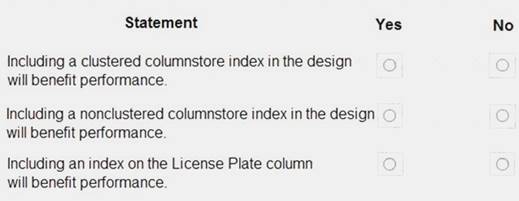
- A. Mastered
- B. Not Mastered
Answer: A
Explanation:
Box 1: No
Data used for Planning Assistance must be stored in a sharded Azure SQL Database. Box 2: Yes
Box 3: Yes
Planning Assistance database will include reports tracking the travel of a single vehicle
NEW QUESTION 4
You need to recommend a backup strategy for CONT_SQL1 and CONT_SQL2. What should you recommend?
- A. Use AzCopy and store the data in Azure.
- B. Configure Azure SQL Database long-term retention for all databases.
- C. Configure Accelerated Database Recovery.
- D. Use DWLoader.
Answer: B
Explanation:
Scenario: The database backups have regulatory purposes and must be retained for seven years.
NEW QUESTION 5
Note: This question is part of a series of questions that present the same scenario. Each question in the series contains a unique solution that might meet the stated goals. Some question sets might have more than one correct solution, while others might not have a correct solution.
After you answer a question in this section, you will NOT be able to return to it. As a result, these
questions will not appear in the review screen.
You are designing an HDInsight/Hadoop cluster solution that uses Azure Data Lake Gen1 Storage. The solution requires POSIX permissions and enables diagnostics logging for auditing.
You need to recommend solutions that optimize storage.
Proposed Solution: Ensure that files stored are larger than 250MB. Does the solution meet the goal?
- A. Yes
- B. No
Answer: A
Explanation:
Depending on what services and workloads are using the data, a good size to consider for files is 256 MB or greater. If the file sizes cannot be batched when landing in Data Lake Storage Gen1, you can have a separate compaction job that combines these files into larger ones.
Note: POSIX permissions and auditing in Data Lake Storage Gen1 comes with an overhead that becomes apparent when working with numerous small files. As a best practice, you must batch your data into larger files versus writing thousands or millions of small files to Data Lake Storage Gen1. Avoiding small file sizes can have multiple benefits, such as:
Lowering the authentication checks across multiple files Reduced open file connections
Faster copying/replication
Fewer files to process when updating Data Lake Storage Gen1 POSIX permissions References:
https://docs.microsoft.com/en-us/azure/data-lake-store/data-lake-store-best-practices
NEW QUESTION 6
Note: This question is part of a series of questions that present the same scenario. Each question in the series contains a unique solution that might meet the stated goals. Some question sets might have more than one correct solution, while others might not have a correct solution.
After you answer a question in this section, you will NOT be able to return to it. As a result, these questions will not appear in the review screen.
You are designing an Azure SQL Database that will use elastic pools. You plan to store data about customers in a table. Each record uses a value for CustomerID.
You need to recommend a strategy to partition data based on values in CustomerID. Proposed Solution: Separate data into customer regions by using horizontal partitioning. Does the solution meet the goal?
- A. Yes
- B. No
Answer: B
Explanation:
We should use Horizontal Partitioning through Sharding, not divide through regions.
Note: Horizontal Partitioning - Sharding: Data is partitioned horizontally to distribute rows across a scaled out data tier. With this approach, the schema is identical on all participating databases. This approach is also called “sharding”. Sharding can be performed and managed using (1) the elastic database tools libraries or (2)
self-sharding. An elastic query is used to query or compile reports across many shards.
References:
https://docs.microsoft.com/en-us/azure/sql-database/sql-database-elastic-query-overview
NEW QUESTION 7
You are designing an application. You plan to use Azure SQL Database to support the application.
The application will extract data from the Azure SQL Database and create text documents. The text documents will be placed into a cloud-based storage solution. The text storage solution must be accessible from an SMB network share.
You need to recommend a data storage solution for the text documents. Which Azure data storage type should you recommend?
- A. Queue
- B. Files
- C. Blob
- D. Table
Answer: B
Explanation:
Azure Files enables you to set up highly available network file shares that can be accessed by using the standard Server Message Block (SMB) protocol.
References:
https://docs.microsoft.com/en-us/azure/storage/common/storage-introduction https://docs.microsoft.com/en-us/azure/storage/tables/table-storage-overview
NEW QUESTION 8
You have an on-premises MySQL database that is 800 GB in size.
You need to migrate a MySQL database to Azure Database for MySQL. You must minimize service interruption to live sites or applications that use the database.
What should you recommend?
- A. Azure Database Migration Service
- B. Dump and restore
- C. Import and export
- D. MySQL Workbench
Answer: A
Explanation:
You can perform MySQL migrations to Azure Database for MySQL with minimal downtime by using the newly introduced continuous sync capability for the Azure Database Migration Service (DMS). This functionality limits the amount of downtime that is incurred by the application. References:
https://docs.microsoft.com/en-us/azure/mysql/howto-migrate-online
NEW QUESTION 9
You are designing a solution for a company. You plan to use Azure Databricks. You need to recommend workloads and tiers to meet the following requirements: Provide managed clusters for running production jobs. Provide persistent clusters that support auto-scaling for analytics processes. Provide role-based access control (RBAC) support for Notebooks.
What should you recommend? To answer, select the appropriate options in the answer area.
NOTE: Each correct selection is worth one point.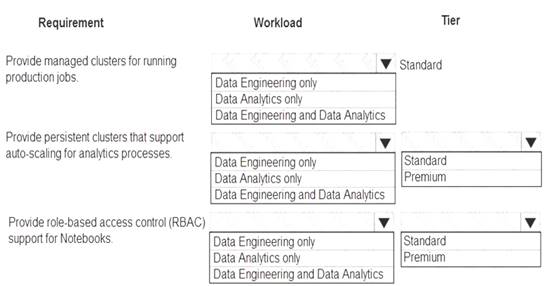
- A. Mastered
- B. Not Mastered
Answer: A
Explanation:
Box 1: Data Engineering Only
Box 2: Data Engineering and Data Analytics Box 3: Standard
Box 4: Data Analytics only Box 5: Premium
Premium required for RBAC. Data Analytics Premium Tier provide interactive workloads to analyze data collaboratively with notebooks
References:
https://azure.microsoft.com/en-us/pricing/details/databricks/
NEW QUESTION 10
You are designing a recovery strategy for your Azure SQL Databases.
The recovery strategy must use default automated backup settings. The solution must include a Point-in time restore recovery strategy.
You need to recommend which backups to use and the order in which to restore backups.
What should you recommend? To answer, select the appropriate configuration in the answer area.
NOTE: Each correct selection is worth one point.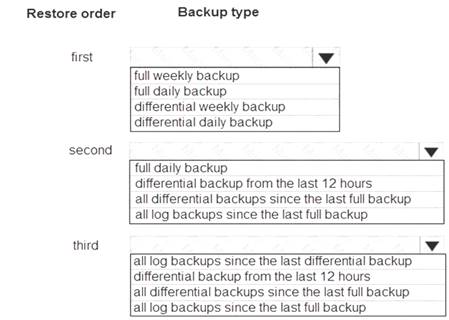
- A. Mastered
- B. Not Mastered
Answer: A
Explanation:
All Basic, Standard, and Premium databases are protected by automatic backups. Full backups are taken every week, differential backups every day, and log backups every 5 minutes.
References:
https://azure.microsoft.com/sv-se/blog/azure-sql-database-point-in-time-restore/
NEW QUESTION 11
A company installs IoT devices to monitor its fleet of delivery vehicles. Data from devices is collected from Azure Event Hub.
The data must be transmitted to Power BI for real-time data visualizations. You need to recommend a solution.
What should you recommend?
- A. Azure HDInsight with Spark Streaming
- B. Apache Spark in Azure Databricks
- C. Azure Stream Analytics
- D. Azure HDInsight with Storm
Answer: C
Explanation:
Step 1: Get your IoT hub ready for data access by adding a consumer group.
Step 2: Create, configure, and run a Stream Analytics job for data transfer from your IoT hub to your Power BI account.
Step 3: Create and publish a Power BI report to visualize the data. References:
https://docs.microsoft.com/en-us/azure/iot-hub/iot-hub-live-data-visualization-in-power-bi
NEW QUESTION 12
You need to design the solution for analyzing customer data. What should you recommend?
- A. Azure Databricks
- B. Azure Data Lake Storage
- C. Azure SQL Data Warehouse
- D. Azure Cognitive Services
- E. Azure Batch
Answer: A
Explanation:
Customer data must be analyzed using managed Spark clusters. You create spark clusters through Azure Databricks. References:
https://docs.microsoft.com/en-us/azure/azure-databricks/quickstart-create-databricks-workspace-portal
NEW QUESTION 13
You design data engineering solutions for a company.
You must integrate on-premises SQL Server data into an Azure solution that performs Extract-Transform-Load (ETL) operations have the following requirements: Develop a pipeline that can integrate data and run notebooks. Develop notebooks to transform the data. Load the data into a massively parallel processing database for later analysis. You need to recommend a solution.
What should you recommend? To answer, select the appropriate options in the answer area.
NOTE: Each correct selection is worth one point.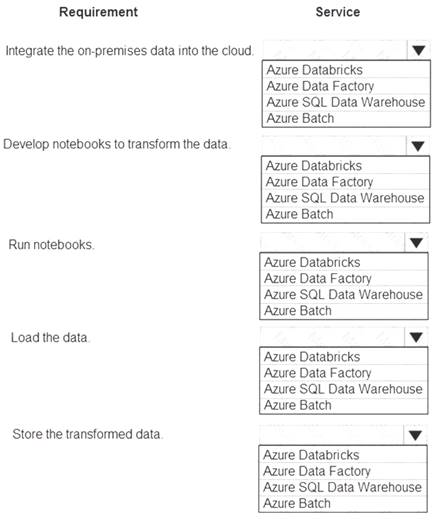
- A. Mastered
- B. Not Mastered
Answer: A
Explanation: 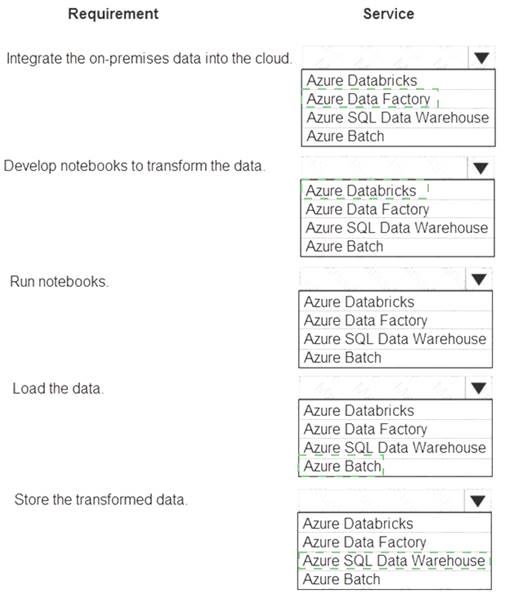
NEW QUESTION 14
You plan to deploy an Azure SQL Database instance to support an application. You plan to use the DTUbased purchasing model.
Backups of the database must be available for 30 days and point-in-time restoration must be possible. You need to recommend a backup and recovery policy.
What are two possible ways to achieve the goal? Each correct answer presents a complete solution.
NOTE: Each correct selection is worth one point.
- A. Use the Premium tier and the default backup retention policy.
- B. Use the Basic tier and the default backup retention policy.
- C. Use the Standard tier and the default backup retention policy.
- D. Use the Standard tier and configure a long-term backup retention policy.
- E. Use the Premium tier and configure a long-term backup retention policy.
Answer: DE
Explanation:
The default retention period for a database created using the DTU-based purchasing model depends on the service tier: Basic service tier is 1 week. Standard service tier is 5 weeks. Premium service tier is 5 weeks.
References:
https://docs.microsoft.com/en-us/azure/sql-database/sql-database-long-term-retention
NEW QUESTION 15
You are designing an Azure Databricks cluster that runs user-defined local processes. You need to recommend a cluster configuration that meets the following requirements:
• Minimize query latency.
• Reduce overall costs.
• Maximize the number of users that can run queries on the cluster at the same time. Which cluster type should you recommend?
- A. Standard with Autoscaling
- B. High Concurrency with Auto Termination
- C. High Concurrency with Autoscaling
- D. Standard with Auto Termination
Answer: C
Explanation:
High Concurrency clusters allow multiple users to run queries on the cluster at the same time, while minimizing query latency. Autoscaling clusters can reduce overall costs compared to a statically-sized cluster.
References:
https://docs.azuredatabricks.net/user-guide/clusters/create.html https://docs.azuredatabricks.net/user-guide/clusters/high-concurrency.html#high-concurrency https://docs.azuredatabricks.net/user-guide/clusters/terminate.html https://docs.azuredatabricks.net/user-guide/clusters/sizing.html#enable-and-configure-autoscaling
NEW QUESTION 16
A company stores data in multiple types of cloud-based databases.
You need to design a solution to consolidate data into a single relational database. Ingestion of data will occur at set times each day.
What should you recommend?
- A. SQL Server Migration Assistant
- B. SQL Data Sync
- C. Azure Data Factory
- D. Azure Database Migration Service
- E. Data Migration Assistant
Answer: C
Explanation:
https://docs.microsoft.com/en-us/azure/data-factory/introduction
https://azure.microsoft.com/en-us/blog/operationalize-azure-databricks-notebooks-using-data-factory/ https://azure.microsoft.com/en-us/blog/data-ingestion-into-azure-at-scale-made-easier-with-latest-enhancements
NEW QUESTION 17
A company manufactures automobile parts. The company installs IoT sensors on manufacturing machinery. You must design a solution that analyzes data from the sensors.
You need to recommend a solution that meets the following requirements: Data must be analyzed in real-time.
Data queries must be deployed using continuous integration. Data must be visualized by using charts and graphs.
Data must be available for ETL operations in the future. The solution must support high-volume data ingestion.
Which three actions should you recommend? Each correct answer presents part of the solution.
NOTE: Each correct selection is worth one point.
- A. Use Azure Analysis Services to query the dat
- B. Output query results to Power BI.
- C. Configure an Azure Event Hub to capture data to Azure Data Lake Storage.
- D. Develop an Azure Stream Analytics application that queries the data and outputs to Power B
- E. Use AzureData Factory to deploy the Azure Stream Analytics application.
- F. Develop an application that sends the IoT data to an Azure Event Hub.
- G. Develop an Azure Stream Analytics application that queries the data and outputs to Power B
- H. Use AzurePipelines to deploy the Azure Stream Analytics application.
- I. Develop an application that sends the IoT data to an Azure Data Lake Storage container.
Answer: BCD
NEW QUESTION 18
A company stores sensitive information about customers and employees in Azure SQL Database. You need to ensure that the sensitive data remains encrypted in transit and at rest.
What should you recommend?
- A. Transparent Data Encryption
- B. Always Encrypted with secure enclaves
- C. Azure Disk Encryption
- D. SQL Server AlwaysOn
Answer: B
Explanation:
References:
https://cloudblogs.microsoft.com/sqlserver/2021/12/17/confidential-computing-using-always-encrypted-withsec
NEW QUESTION 19
You plan to use an Azure SQL data warehouse to store the customer data. You need to recommend a disaster recovery solution for the data warehouse. What should you include in the recommendation?
- A. AzCopy
- B. Read-only replicas
- C. AdICopy
- D. Geo-Redundant backups
Answer: D
Explanation:
References:
https://docs.microsoft.com/en-us/azure/sql-data-warehouse/backup-and-restore
NEW QUESTION 20
A company has many applications. Each application is supported by separate on-premises databases. You must migrate the databases to Azure SQL Database. You have the following requirements: Organize databases into groups based on database usage.
Define the maximum resource limit available for each group of databases.
You need to recommend technologies to scale the databases to support expected increases in demand. What should you recommend?
- A. Read scale-out
- B. Managed instances
- C. Elastic pools
- D. Database sharding
Answer: C
Explanation:
SQL Database elastic pools are a simple, cost-effective solution for managing and scaling multiple databases that have varying and unpredictable usage demands. The databases in an elastic pool are on a single Azure SQL Database server and share a set number of resources at a set price.
You can configure resources for the pool based either on the DTU-based purchasing model or the vCorebased purchasing model.
NEW QUESTION 21
You are developing a solution that performs real-time analysis of IoT data in the cloud. The solution must remain available during Azure service updates.
You need to recommend a solution.
Which two actions should you recommend? Each correct answer presents part of the solution.
NOTE: Each correct selection is worth one point.
- A. Deploy an Azure Stream Analytics job to two separate regions that are not in a pair.
- B. Deploy an Azure Stream Analytics job to each region in a paired region.
- C. Monitor jobs in both regions for failure.
- D. Monitor jobs in the primary region for failure.
- E. Deploy an Azure Stream Analytics job to one region in a paired region.
Answer: BC
Explanation:
Stream Analytics guarantees jobs in paired regions are updated in separate batches. As a result there is a sufficient time gap between the updates to identify potential breaking bugs and remediate them.
Customers are advised to deploy identical jobs to both paired regions.
In addition to Stream Analytics internal monitoring capabilities, customers are also advised to monitor the jobs as if both are production jobs. If a break is identified to be a result of the Stream Analytics service update, escalate appropriately and fail over any downstream consumers to the healthy job output. Escalation to support will prevent the paired region from being affected by the new deployment and maintain the integrity of the paired jobs.
References:
https://docs.microsoft.com/en-us/azure/stream-analytics/stream-analytics-job-reliability
NEW QUESTION 22
You need to design the runtime environment for the Real Time Response system. What should you recommend?
- A. General Purpose nodes without the Enterprise Security package
- B. Memory Optimized Nodes without the Enterprise Security package
- C. Memory Optimized nodes with the Enterprise Security package
- D. General Purpose nodes with the Enterprise Security package
Answer: B
NEW QUESTION 23
Note: This question is part of a series of questions that present the same scenario. Each question in the series contains a unique solution that might meet the stated goals. Some question sets might have more than one correct solution, while others might not have a correct solution.
After you answer a question in this section, you will NOT be able to return to it. As a result, these questions will not appear in the review screen.
A company is developing a solution to manage inventory data for a group of automotive repair shops. The solution will use Azure SQL Data Warehouse as the data store.
Shops will upload data every 10 days.
Data corruption checks must run each time data is uploaded. If corruption is detected, the corrupted data must be removed.
You need to ensure that upload processes and data corruption checks do not impact reporting and analytics processes that use the data warehouse.
Proposed solution: Configure database-level auditing in Azure SQL Data Warehouse and set retention to 10 days.
Does the solution meet the goal?
- A. Yes
- B. No
Answer: B
Explanation:
Instead, create a user-defined restore point before data is uploaded. Delete the restore point after data corruption checks complete.
References:
https://docs.microsoft.com/en-us/azure/sql-data-warehouse/backup-and-restore
NEW QUESTION 24
......
100% Valid and Newest Version DP-201 Questions & Answers shared by Certshared, Get Full Dumps HERE: https://www.certshared.com/exam/DP-201/ (New 74 Q&As)
- The Secret of Microsoft 70-535 exam dumps
- Free SharePoint 70-486 pdf
- The Secret of Microsoft 70-410 dumps
- Accurate MB2-713 Exam Questions and Answers 2021
- Tested Windows Server 70-414 exam dumps
- The Most up-to-date Guide To 70-494 braindumps
- Renew Microsoft Power Platform Developer PL-400 Exam Guide
- Download 70-743 Study Guides 2021
- A Review Of Best Quality 70-494 practice test
- Verified AZ-203 Study Guides 2021